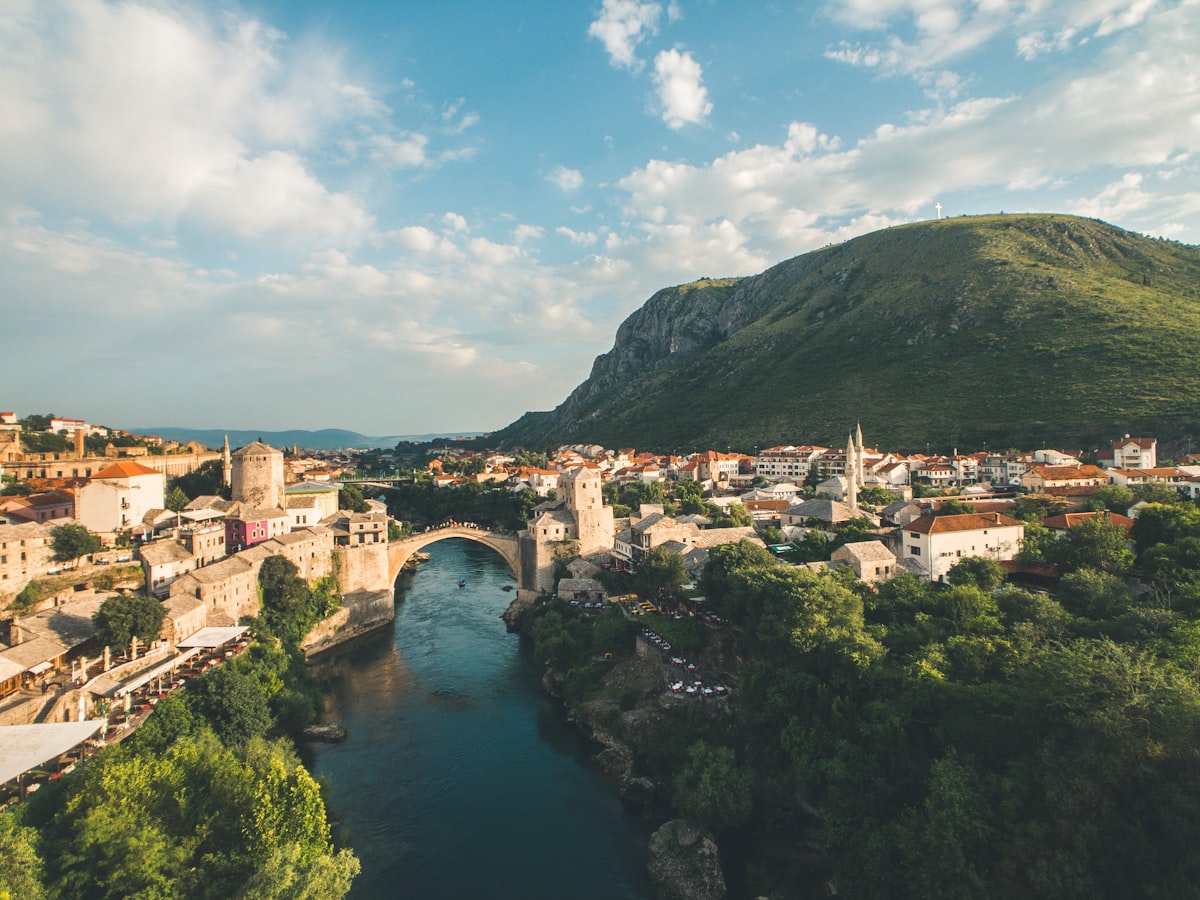
Ask ten people which countries are in the Balkans and you will get ten slightly different lists. The Balkans is a region, not an official bloc, and nobody holds a definitive border for it. What we can do is lay out the competing definitions, show which countries sit inside each one, and explain what matters for a traveller: who is in the EU, who is in Schengen, and which currency you will need. This page is the starting point for everything else on The Balkan Guide, and every country below links to its full guide.
What does “the Balkans” actually mean?
The name comes from the Balkan Mountains (Stara Planina) in Bulgaria, and for more than a century it has been applied to the whole south-eastern European peninsula. Three definitions are in common use.
Geographic. The Balkan Peninsula is bounded by the Adriatic and Ionian seas to the west, the Aegean to the south and the Black Sea to the east. The northern edge is loosely drawn along the Sava and Danube rivers. By this reading the region includes Albania, Bosnia and Herzegovina, Bulgaria, Kosovo, Montenegro, North Macedonia, Serbia, most of Croatia, southern Slovenia, mainland Greece and a slice of European Türkiye. Romania is often included because of the Danube delta and its Balkan-facing south, though it is debated.
Political. “Western Balkans” is the term used by the European Union for the countries that emerged from former Yugoslavia, plus Albania, that are not yet members: Albania, Bosnia and Herzegovina, Kosovo, Montenegro, North Macedonia and Serbia. Croatia and Slovenia, former Yugoslav republics that joined the EU in 2013 and 2004, are now usually called Central or Southern Europe by their own governments, even though they are Balkan on a map.
Cultural. Shared history under the Ottoman and Habsburg empires, Orthodox, Catholic and Muslim traditions living side by side, and a common food culture of grilled meat, burek, strong coffee and rakija. This definition is fuzzy by nature, which is why Greece and Romania are argued over.
For trip planning we use a practical middle path: the ten countries below. Slovenia and Greece sit at the edges, and we keep them because travellers routinely combine them with the core.
The Balkan countries, one by one
Albania
Albania is the Adriatic’s late bloomer: a Riviera of pale beaches around Ksamil and Saranda, the Ottoman stone cities of Berat and Gjirokaster, and the Albanian Alps for hiking. Tirana is the lively capital. It is cheaper than Croatia and Montenegro, though August prices are catching up. Read the full Albania travel guide.
Bosnia and Herzegovina
Bosnia packs the region’s deepest layers of history into a small area: the rebuilt Stari Most bridge at Mostar, the Ottoman bazaar and siege-era sites of Sarajevo, and rafting on the Neretva and Una rivers. Two entities and one district share the country, which matters when you read bus timetables. Read the full Bosnia and Herzegovina travel guide.
Bulgaria
Bulgaria gives you the Balkan Mountains themselves, Black Sea resorts at Varna and Nessebar, the Roman and Thracian layers of Plovdiv, and skiing at Bansko at a fraction of Alpine prices. Sofia is a compact, walkable capital. Read the full Bulgaria travel guide.
Croatia
Croatia is the region’s heavyweight for tourism, with more than 1,200 islands, walled Dubrovnik, Diocletian’s Palace in Split and the terraced lakes of Plitvice. It is also the most expensive Balkan country in summer. Read the full Croatia travel guide.
Greece
Greece is the debated member. Mainland northern Greece, including Thessaloniki, is on the Balkan peninsula and links overland to North Macedonia and Albania, and Corfu is a short ferry from Saranda. We cover it as a complement to a Balkans trip. Read the full Greece guide.
Kosovo
Kosovo is Europe’s youngest country, declared independent in 2008 and recognised by around half of UN members, which affects border logistics for some routes. Pristina has a young, café-heavy energy, Prizren is the Ottoman showpiece and Peja is the gateway to the Accursed Mountains. Read the full Kosovo travel guide.
Montenegro
Montenegro is small enough to cross in a few hours and varied enough to justify a week: the fjord-like Bay of Kotor around Kotor and Perast, Adriatic beaches near Budva, and the Durmitor mountains above Zabljak. Read the full Montenegro travel guide.
North Macedonia
North Macedonia is the region’s quiet value pick. Lake Ohrid is one of Europe’s oldest lakes, Skopje mixes Ottoman bazaar with eccentric statue-heavy renewal, and Matka Canyon is a half-day trip from the capital. Read the full North Macedonia travel guide.
Serbia
Serbia is the inland centre of the region. Belgrade is known for its river nightlife and the Kalemegdan fortress, Novi Sad for Petrovaradin and the EXIT festival legacy, and the south for monasteries and mountain scenery near Nis. Read the full Serbia travel guide.
Slovenia
Slovenia is the northwestern fringe and the easiest introduction: Ljubljana, Lake Bled, Lake Bohinj, the coastal town of Piran and the Soca Valley. It borders Italy, Austria and Hungary as well as Croatia, so it works as an entry point. Read the full Slovenia travel guide.
Romania and Moldova: the edge cases
Romania and Moldova appear on some Balkan lists because of the Danube and shared history, but most geographers and almost all locals place them in Eastern or Central Europe. We do not publish country hubs for them, and we do not count them in the ten above.
Balkan countries at a glance: EU, Schengen and currency
Status as of October 2026. Always check official sources before travelling, as rules change.
| Country | EU status | Schengen | Currency |
|---|---|---|---|
| Albania | Candidate | No | Lek (ALL) |
| Bosnia and Herzegovina | Candidate | No | Convertible mark (BAM) |
| Bulgaria | Member (2007) | Yes | Euro (since Jan 2026) |
| Croatia | Member (2013) | Yes (since 2023) | Euro (since 2023) |
| Greece | Member (1981) | Yes | Euro |
| Kosovo | Potential candidate | No | Euro (unilateral) |
| Montenegro | Candidate | No | Euro (unilateral) |
| North Macedonia | Candidate | No | Denar (MKD) |
| Serbia | Candidate | No | Dinar (RSD) |
| Slovenia | Member (2004) | Yes | Euro (since 2007) |
Two points catch travellers out. First, the Schengen 90/180-day rule applies only inside the Schengen countries; non-Schengen Balkan countries run their own clocks, so time spent in Albania or Serbia does not count against your Schengen days. Our Schengen 90/180 guide explains how to plan a long trip. Second, Montenegro and Kosovo use the euro without being in the eurozone, so you never need to exchange money there but you will still deal with borders. For the money side, see the Balkans currency guide, and for entry requirements by passport see the Balkans visa guide.
A Balkans map in words
Without a drawn map, it helps to picture the region as three bands.
- The Adriatic coast, west to south: Slovenia’s short coastline, Croatia’s long one, then Montenegro and Albania, with Greece’s Ionian coast at the end.
- The inland core: Bosnia and Herzegovina, Serbia, Kosovo and North Macedonia, mostly mountains and river valleys running north to south.
- The east: Bulgaria, facing the Black Sea, with the Balkan Mountains running across its middle.
Capitals follow the same pattern. A typical north-to-south overland line runs Ljubljana, Zagreb, Sarajevo, Podgorica, Tirana, Skopje, with Belgrade, Pristina and Sofia sitting on a second line inland. Distances are short: most neighbouring capitals are four to eight hours apart by bus. If you need routes, our one week, 10 day and two week itineraries show tested sequences.
Which Balkan countries should you visit first?
First-timers who want beaches, history and easy logistics should start on the Adriatic: Croatia and Montenegro, with Albania added for a cheaper coast. Travellers who care more about culture and food should pair Bosnia and Herzegovina with Serbia. Budget travellers will find the best value in North Macedonia, Bulgaria and Albania. Hikers should look at Montenegro, Albania’s northern mountains, Slovenia and Bulgaria. If you only have one trip, our Balkans tourism statistics show which countries are busiest and where you can still find space, and the language guide and etiquette guide prepare you for the road.
Frequently asked questions
What are the Western Balkans? The EU’s term for the six non-member countries of the region: Albania, Bosnia and Herzegovina, Kosovo, Montenegro, North Macedonia and Serbia.
Is Croatia a Balkan country? Geographically, partly. Croatia’s own tourism branding prefers Mediterranean or Central European, but travel guides and most visitors treat it as part of the Balkans, and it is the easiest country to combine with its neighbours.
Can I visit several Balkan countries in one trip? Yes, and most travellers do. Borders are short and bus networks link the capitals; check each country’s entry rules, since several crossings involve non-Schengen checks even for EU passport holders.