Balkan cuisine is one of Europe’s most underrated food traditions. It draws on Ottoman, Greek, Austro-Hungarian, and Mediterranean influences without being a copy of any of them, and the price-to-quality ratio in most cities is significantly better than in Western Europe. A serious sit-down dinner at one of Belgrade’s best restaurants costs approximately €25–40 per person; the equivalent in Vienna costs three times that. This guide is for travellers who plan their itinerary around food: the best cities, markets, signature dishes, and food tours worth booking.
Why the Balkans for Food Travel
Balkan cooking is built around fresh ingredients, slow preparation, and a culture of hospitality that treats food as central — not incidental — to a visit. Grilled meat is the backbone: cevapi (skinless sausages), pljeskavica (spiced minced-meat patties), and ćevapčići are everywhere, but the regional variations are substantial. Albania’s byrek (filo pastry with cheese or spinach) is nothing like the Croatian burek. North Macedonia’s tavce-gravce (baked beans with peppers and pork) is a dish you will not find anywhere else.
The dairy tradition is strong across the region: Albanian kos (strained yoghurt), Macedonian cheese, Montenegrin kacamak (cornmeal with cheese and cream) — these are ingredients that rarely appear on international menus. The seafood along the Adriatic (Croatia, Montenegro, Albania Riviera) is among the freshest in Europe.
The region also has a serious coffee culture, a cake-shop tradition (particularly in Bosnia and Croatia), and local wine and rakija (fruit brandy) that is worth pursuing at source.
Best Food Cities
Sarajevo
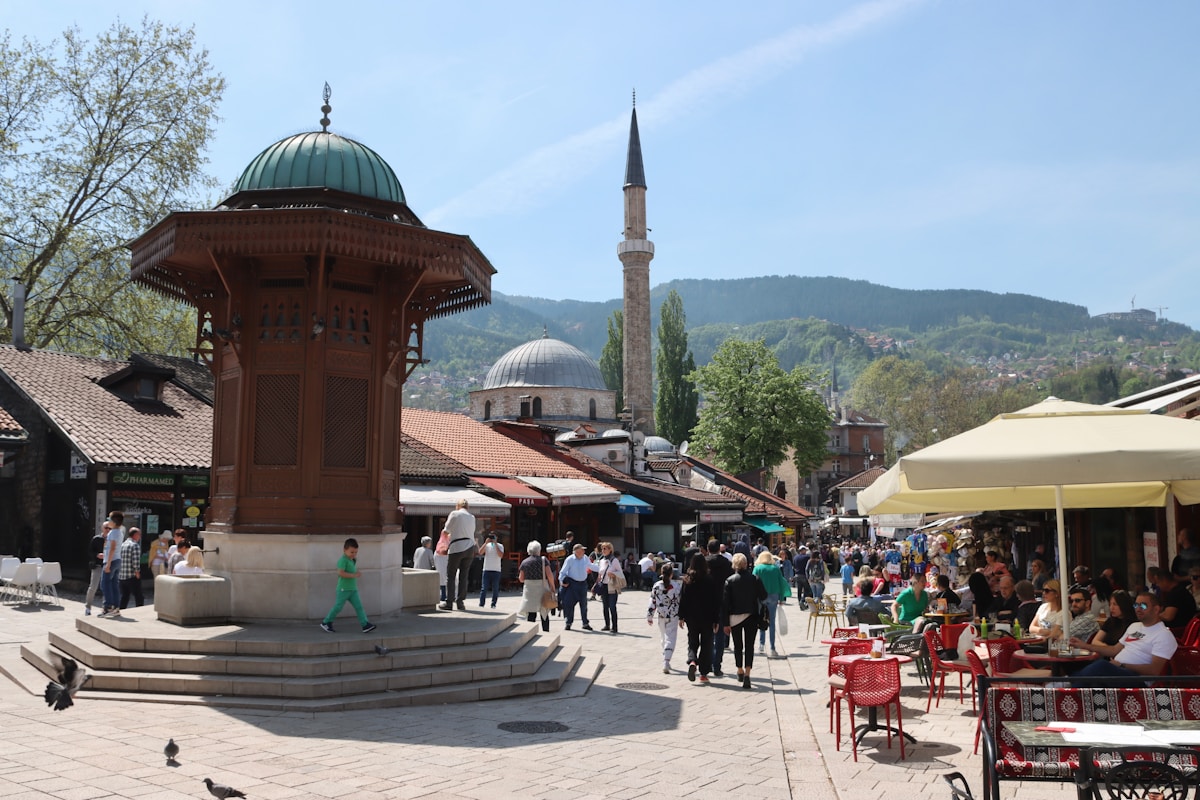
Sarajevo’s food identity is centred on Baščaršija, the Ottoman bazaar, and on cevapi specifically. Sarajevski cevapi — thin skinless sausages served in soft somun flatbread with raw onion — are a different animal from the Serbian version: smaller, softer, made only with veal and lamb. The canonical address is Ćevabdžinica Žujo (Bravadžiluk 2, Baščaršija) and Petica Cazin (Mula Mustafe Bašeskije). A portion (six or ten pieces) with bread, kajmak (clotted cream), and ajvar (roasted pepper relish) costs approximately €4–6 as of 2026.
Beyond cevapi: Sarajevo has a strong burek tradition (Buregdžinica Bosna on Bravadžiluk opens at 6:00 AM; burek approximately €2), a Turkish coffee culture that produces a ceremonially slow cup in a copper džezva, and a sweet shop tradition that runs to baklava, hurmasice (honey-soaked cakes), and tufahija (stuffed poached apple with cream). Full Sarajevo guide.
Belgrade
Serbia’s capital is the most ambitious food city in the Balkans by contemporary restaurant standards, but it also has the most serious traditional meat culture in the region. The classic Belgrade cuts — roštilj (mixed grill), pljeskavica stuffed with kaymak, jagnjetina ispod sača (lamb under a cast iron bell) — are available at their best in the Skadarlija bohemian quarter.
Contemporary dining has moved significantly upwards in quality since 2015. Proper cocktail bars, natural wine lists, and menus driven by local seasonal ingredients are now concentrated in the Savamala district. A high-end dinner at a creative Serbian restaurant (Salon 1905, Salon de l’Académie, or equivalent) costs approximately €30–45 per person including wine as of 2026. Full Belgrade guide.
Thessaloniki
Consistently ranked Greece’s best food city. The city claims several dishes: bougatsa (warm custard or cheese filo, dusted with cinnamon), koulouri Thessalonikis (crispier sesame bread ring than the Athens version), and trigona Panoramatos (cream-filled filo triangles). The covered Modiano and Kapani markets are the best markets for food browsing in the Balkans — fresh fish, olives, local cheeses, herbs, and pastry shops in close proximity. Full Thessaloniki guide.
Zagreb
Croatia’s capital has the most developed café and patisserie culture in the Balkans, alongside a strong market tradition at Dolac (the open-air market above the main square, open daily from 07:00–14:00). Strukli (dough parcels filled with cottage cheese, served boiled or baked) is the Zagreb speciality — Šestinski restoran (Šestine village, 20 minutes from centre) is the classic address. Contemporary restaurants are concentrated in the Gornji Grad (Upper Town) and around Tkalčićeva Street. Full Zagreb guide.
Tirana
Albanian cuisine is one of the least-known in the region but has distinctive characteristics: byrek made with wild herbs and mountain vegetables (not just cheese or meat), ferges (a ricotta, tomato, and offal dish cooked in earthenware), and qofte (spiced meatballs with yoghurt). The Blloku district has seen serious restaurant investment since 2018 — Mrizi i Zanave (about 45 km from Tirana, in Fishte) is the most-cited farm-to-table restaurant in Albania, worth the drive. Full Tirana guide.
Best Markets
Baščaršija, Sarajevo — the Ottoman bazaar is primarily a craft market but the surrounding streets have food vendors, sweet shops, and the best concentration of traditional Bosnian food in one place.
Dolac Market, Zagreb — the best produce market in the region. Arrive before 09:00 for the full selection.
Modiano and Kapani, Thessaloniki — covered markets with fish, cheese, olives, spices, and the best street pastry in Greece.
Tirana Old Bazaar area — informal but atmospheric; best for byrek shops and traditional Albanian sweets.
Plovdiv Old Town, Bulgaria — a cluster of craft producers and food shops in the 19th-century revival district; excellent local wines, cheeses, and rose-based products.
Must-Try Dishes by Country
Bosnia: Cevapi (skinless sausages in somun), burek (filo pastry), dolma (stuffed peppers or vine leaves), tufahija (poached apple dessert)
Serbia: Pljeskavica (stuffed patty), ajvar (roasted pepper condiment), prebranac (baked beans with onions), slatko (preserved whole fruit in syrup)
Croatia: Strukli (cheese dough parcels), black risotto (crni rižoto, with squid ink, Dalmatia), Pag cheese, fritule (small doughnuts, Dalmatian Christmas)
Albania: Byrek (filo), tavë kosi (baked lamb with yoghurt), fërgesë, spit-roast lamb
North Macedonia: Tavce-gravce (baked beans), ajvar (the best in the Balkans), Ohrid trout, mastika (anise spirit)
Bulgaria: Banitsa (cheese filo pastry), kavarma (clay-pot stew), shopska salata (tomato, cucumber, white cheese)
Montenegro: Kacamak (cornmeal with cheese), njeguški pršut (cured ham from Njeguši village), Njeguški sir (smoked cheese)
Greece/Thessaloniki: Bougatsa, souvlaki, grilled octopus, fresh fish at the port
Food Tours Worth Booking
Most major cities have specialist food tours that are worth the price if you want context alongside the eating. In Sarajevo, a 3-hour Baščaršija food walk covering cevapi, burek, Turkish coffee, and Bosnian sweets costs approximately €25–35 per person. Belgrade food tours often combine the Skadarlija market, the Kalenić open-air market, and a kafana lunch — approximately €30–45 per person. Thessaloniki food tours covering the markets, bougatsa shops, and a wine tasting run approximately €40–55.
Browse food tours across the Balkans for current availability.
Practical Tips for Food Travel
Budget: Eating well costs less here than almost anywhere in Europe. In Sarajevo and Skopje, a full sit-down lunch at a good traditional restaurant costs €6–10 per person. In Zagreb and Dubrovnik (the most expensive cities), expect €12–18. Belgrade’s creative restaurants are €25–40 for dinner. Street food and market food rarely exceeds €3–5 for a full portion.
Rakija: The local fruit brandy — plum (šljivovica), quince (dunja), grape (loza) — is central to Balkan food culture. It is typically served as a digestif or welcome drink, not cocktail-mixed. Quality varies enormously; good home-distilled rakija from a village in Serbia or Bosnia is excellent; mass-produced bottle-shop versions less so.
Dietary restrictions: Vegetarian eating is possible but requires navigation — many dishes described as vegetarian contain pork stock or meat by default. Sarajevo and Belgrade have dedicated vegetarian restaurants. Vegan eating is harder outside major cities. See our vegan food guide for Albania and vegan food for Serbia for city-by-city breakdowns.
When to visit for food: September–October is the best season — harvest produce, markets at full stock, cooler weather for long meals. September is ajvar season in Serbia and North Macedonia.
See Also
- Balkan food guide
- Sarajevo restaurants
- Belgrade restaurants
- Thessaloniki restaurants
- Zagreb restaurants
- Backpacking the Balkans on a budget
Plan your trip: Browse food tours and cooking experiences in the Balkans — from Sarajevo cevapi walks to Belgrade market tours. Travel protected with Balkans travel insurance.