Thessaloniki Travel Guide
Thessaloniki travel guide: White Tower, Byzantine churches, Roman monuments, and the best food city in Greece. Gateway to Greece from the Balkans.
Thessaloniki is Greece’s second-largest city and the most natural Greek gateway for travellers coming from the Balkans. Skopje sits approximately 3 hours north by bus; Ohrid is around 2.5 hours. The city has been accumulating layers of civilisation for over 2,300 years — Roman, Byzantine, Sephardic Jewish, Ottoman — and the result is a textured place with better food than Athens and far fewer tourists. All prices in euros (€).
Why visit Thessaloniki
Thessaloniki is consistently ranked as Greece’s best food city. It is also one of the most historically layered places in the Balkans — the Rotunda was built as a Roman mausoleum in 300 AD, converted to a Byzantine church, and later to an Ottoman mosque, all within the same walls. The city hosts multiple UNESCO-recognised monuments, one of the best archaeological museums in Greece, and a waterfront promenade that runs for kilometres along the Thermaic Gulf. It is less polished and self-consciously touristic than Athens, which many visitors find a relief.
Key attractions
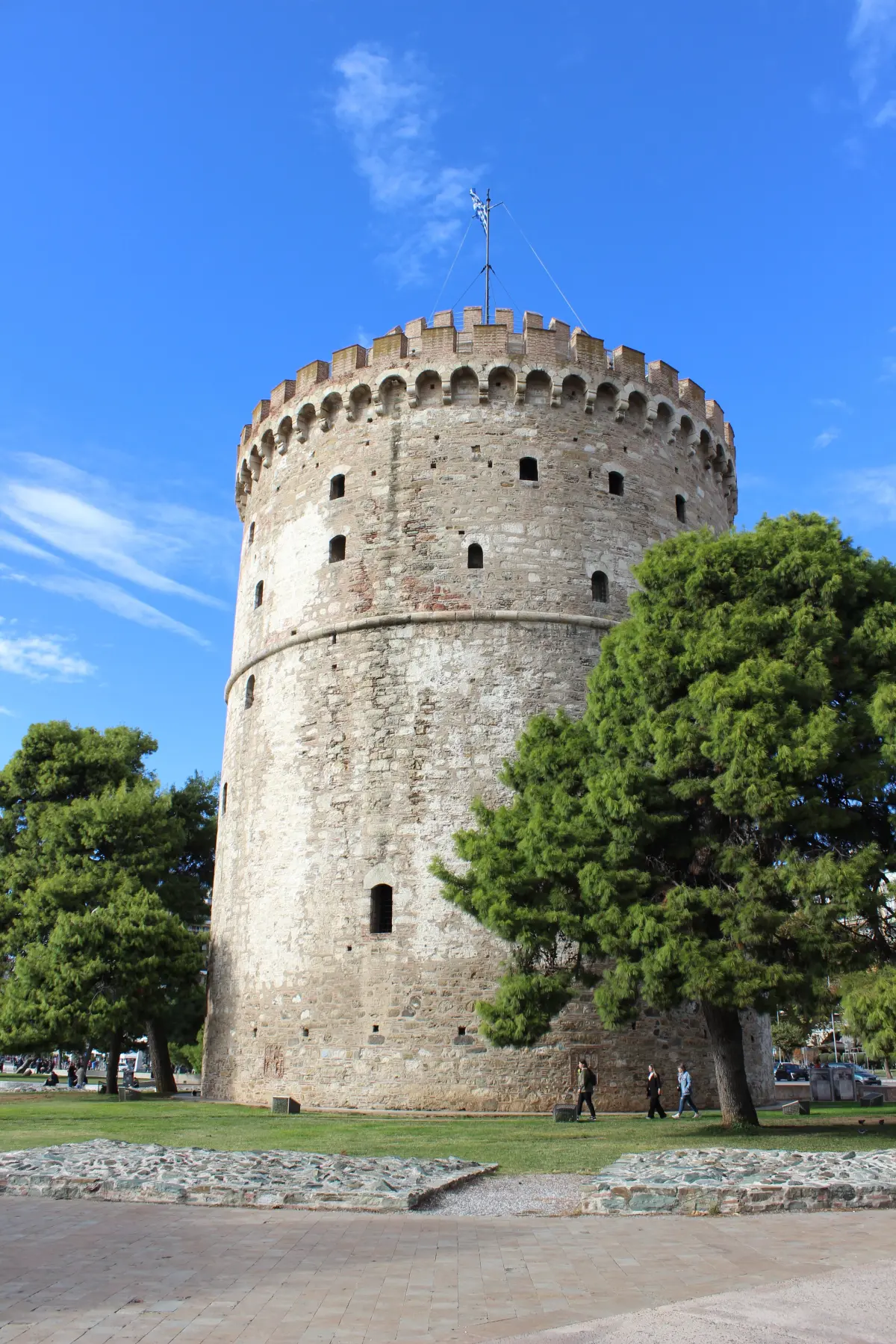
The White Tower is the city’s defining landmark — a 15th-century Ottoman fortification on the waterfront promenade. Entry is approximately €4 (as of 2026). The interior holds a permanent exhibition tracing Thessaloniki’s history through the Byzantine and Ottoman periods. The view from the top over the Thermaic Gulf is the best in the city; allow 45–60 minutes.
Ano Poli (Upper Town) is the old Byzantine quarter, which survived the 1917 fire that destroyed much of the lower city. Winding cobblestone lanes, surviving sections of 4th-century Byzantine walls, small Ottoman-era mosques converted to churches, and neighbourhood tavernas. The views down to the bay and across to Mount Olympus on clear days are exceptional. Entry to the neighbourhood is free; the walls can be walked in 30–45 minutes.
Rotunda (Galerius Rotunda) is the most historically layered monument in the city — a circular Roman mausoleum built for Emperor Galerius around 300 AD, later converted into a Byzantine church (with magnificent 4th-century mosaics still intact), and then an Ottoman mosque during the Tourkokratia. Entry approximately €4 (as of 2026). Do not miss the surviving ceiling mosaics inside — they are some of the finest early Christian art in existence.
Arch of Galerius (Kamara) stands directly adjacent to the Rotunda. This Roman triumphal arch was erected around 298 AD to celebrate Galerius’s victory over the Persians. Entry is free; the relief carvings on the surviving piers show battle scenes in exceptional detail. The Kamara neighbourhood around the arch is one of the best areas for coffee and evening drinks.
Archaeological Museum of Thessaloniki holds one of the finest collections of ancient Macedonian artefacts in the world, including gold funeral wreaths, bronze armour, and grave goods from the royal Macedonian tombs. Entry approximately €8 (as of 2026). Allow 2 hours minimum. The museum sits at the eastern end of the main park, 10 minutes’ walk from the waterfront.
Museum of Byzantine Culture houses what is widely considered the best Byzantine museum collection in Greece — Early Christian, Byzantine, and post-Byzantine artefacts, mosaics, frescoes, and metalwork across 11 galleries. Entry approximately €8 (as of 2026). Sits next to the Archaeological Museum; a combined visit takes most of a day.
Modiano and Kapani markets are the city’s covered markets — fish stalls, cheese shops, herb and spice sellers, mezze ingredients, and Thessaloniki’s famous koulouri vendors. The atmospheric warren of the Kapani (Vlali) market is best explored in the morning. Food is cheap: a koulouri (sesame-encrusted bread ring) costs approximately €0.50; a serving of freshly fried loukoumades (honey doughnuts) approximately €3.
Aristotelous Square is the city’s main civic space — a formal neoclassical waterfront piazza flanked by colonnaded buildings designed by Ernest Hébrard in the 1920s rebuild. The cafes lining the square are more tourist-facing than the Ladadika or Ano Poli options, but the setting and sea views are excellent.
Where to eat
Thessaloniki’s food reputation is well-earned. The city claims several dishes as its own, and the density of good restaurants and pastry shops within walking distance of the centre is unusually high.
What to eat specifically in Thessaloniki:
- Bougatsa — custard or cheese-filled filo pastry, served warm and dusted with icing sugar and cinnamon. Thessaloniki is the most serious city for bougatsa in Greece. Bougatsa Bantis (near the market area, Komninon 1) and Bougatsa Thessaloniki (Eleftherias Square) are the most cited specialist shops; portions approximately €2.50–3.
- Trigona Panoramatos — cream-filled filo pastry triangles, invented at the Trigono pastry shop in the upper city. The shop itself (Navarino 5, Panorama neighbourhood) is the original; approximately €2 per piece.
- Koulouri Thessalonikis — the city’s version of the sesame bread ring, larger and crispier than the Athens version. From street vendors at approximately €0.50.
- Grilled octopus — widely available at waterfront tavernas; approximately €12–16 as of 2026.
- Patsas (tripe soup) — an acquired taste but central to the Thessaloniki food culture; served at late-night patsatzidika around the market area.
Recommended restaurants:
- Zythos (Ladadika, Katouni 5) — one of the most popular traditional tavernas in the city; excellent mezze, grilled meats, and draught beer in the atmospheric old warehouse district. Mains approximately €10–16 as of 2026; reservations advisable for evenings.
- Myrovolos Smyrni (Komninon 32, near Modiano) — a long-established meze restaurant known for its lamb dishes, grilled fish, and Smyrni-origin recipes. Mains approximately €10–18 as of 2026.
- To Makedonomaheion (Proxenou Koromila, city centre) — traditional Greek home cooking; daily specials written on a chalk board; reliable and inexpensive. Mains approximately €8–13 as of 2026.
- Ano Poli tavernas — the upper town has a cluster of neighbourhood tavernas (particularly around Kassandrou and Eptapyrgiou streets) with terrace seating and views. Uneven in quality but the setting compensates; expect mains of €10–16 as of 2026.
- Ergon House (Nikis 2) — a large modern food hall and delicatessen near the waterfront with high-quality Greek produce, charcuterie, cheese, bread, and prepared foods. Good for a casual lunch; approximately €10–18 per person.
Budget meal: koulouri and bougatsa at the market for under €4. A sit-down lunch at a mid-range taverna: €12–18 per person. A proper dinner with wine at Zythos or Myrovolos: €22–35 per person as of 2026.
Where to stay
Thessaloniki’s accommodation is concentrated in three areas: the waterfront and Aristotelous Square zone, the Ladadika warehouse district (good for nightlife proximity), and the Ano Poli upper town (quieter, views, fewer tourist facilities). Prices below are per-night for a double room in shoulder season (May–June, September–October) as of 2026.
| Budget | Hotel | Price (€/night) | Notes |
|---|---|---|---|
| Budget | Tourist Hotel | €45–70 | Central location near Egnatia; simple and reliable |
| Mid-range | Capsis Hotel | €75–115 | Central; rooftop pool; solid 4-star; good value |
| Mid-range | City Hotel Thessaloniki | €80–120 | Modern design; well-located near Aristotelous Square |
| Upper-mid | Mediterranean Palace | €110–160 | Waterfront position; business hotel with good breakfast |
| Upper-mid | Electra Palace Thessaloniki | €140–210 | Flagship 5-star on Aristotelous Square; rooftop pool with sea views |
| Luxury | Hyatt Regency Thessaloniki | €190–290 | Convention-scale luxury; best facilities in the city |
Browse hotels in Thessaloniki for current availability and rates.
Day trips from Thessaloniki
Vergina (Aigai) — 70 km, 1 hour by car. The royal necropolis of ancient Macedonia. The Great Tumulus contains the intact tomb of Philip II, father of Alexander the Great, with gold burial caskets, armour, and grave goods on display in situ. Entry approximately €12 (as of 2026). One of the most important archaeological sites in Greece and easily paired with a morning in Thessaloniki.
Pella — 40 km, 40 minutes by car. The birthplace of Alexander the Great and capital of ancient Macedonia. The archaeological site includes well-preserved mosaic floors from the 4th century BC. Entry approximately €8 (as of 2026). Best combined with a Vergina visit as a full-day ancient Macedonia circuit.
Halkidiki peninsula — 60–90 km, 1–1.5 hours by car. Thessaloniki’s beach getaway — three peninsulas (Kassandra, Sithonia, Athos) with clear Aegean water and pine forests running down to the coast. Mount Athos (the third peninsula) is a monastic community accessible to men only by permit. Kassandra is the most developed; Sithonia is quieter with better beaches.
Mount Olympus — 90 km, 1.5 hours via Litochoro. Greece’s highest peak (2,917 m) and home of the gods in Greek mythology. The trailhead village of Litochoro sits at the base; trails to the Refuge A hut at 2,100 m and Mytikas summit are well-marked. Best as a day trip for lower trails; summit requires an overnight.
Getting to Thessaloniki
From Skopje: approximately 3 hours by bus; approximately €15–20 one way. Multiple daily departures. By car via the E75 motorway (Evzoni border crossing): approximately 2.5 hours.
From Ohrid: approximately 2.5 hours by bus via Florina and the Niki border crossing; approximately €15. No direct bus; connections often require a change at Florina.
From Tirana: approximately 7–9 hours by bus, €25–40; operators depart from Tirana International Bus Station. Flying takes approximately 1 hour; Air Albania and other carriers serve the route.
From Sofia: approximately 4 hours by bus; approximately €15–25. Connections run via Kulata and the Promachonas border crossing.
By air (Thessaloniki Airport, SKG): Greece’s second airport. Domestic flights from Athens take approximately 55 minutes; booked in advance, fares can be €30–60 one way. International connections to most European hubs. The airport is 16 km southeast of the city; bus route 78 connects the airport to the city centre (approximately €1.20; 45–60 minutes). Taxis cost approximately €25–35.
Getting around
The city centre between the White Tower, Aristotelous Square, Modiano Market, and Ano Poli is walkable — approximately 30–40 minutes end to end on flat terrain; the climb to Ano Poli adds 20–25 minutes from the waterfront. Local buses cover the wider city. Taxis are inexpensive; Uber and Beat (the local ride-hailing app) operate in Thessaloniki.
When to visit
May–June and September–October are the best months. Warm enough for the waterfront and day trips; manageable crowds; shoulder-season hotel prices.
July–August are busy and hot (35°C+ is common). Beach resorts nearby fill up; the city itself has thin summer crowds as locals head to Halkidiki. Accommodation prices rise.
November–March is quieter and cooler. Most museums and historical sites remain open year-round. Rain is more frequent November–January.
Thessaloniki in the broader Balkans circuit
Thessaloniki works best as a 2–3 day extension to a North Macedonia or Albania leg, or as a standalone city break. From a Balkans base:
- Skopje + Thessaloniki: natural 4–5 day pairing; bus between them is fast and cheap.
- Ohrid + Thessaloniki: add a night in Ohrid en route; the Lake Ohrid to Florina to Thessaloniki route is scenic.
- Tirana + Thessaloniki: longer but viable; 7–9 hours overland or a short flight. See our Tirana vs Thessaloniki comparison for the full breakdown.
For the broader Albania–Greece route, see Albania vs Greece.
See also
- Greece travel guide
- North Macedonia travel guide
- Skopje
- Ohrid
- Tirana vs Thessaloniki
- Albania vs Greece
- Balkans Schengen day-count guide
Plan your trip: Browse guided tours and activities in Greece to see what’s available, from Thessaloniki walking tours to day trips to Vergina and Halkidiki. Find hotels in Thessaloniki and cover your journey with Balkans travel insurance.
Book an experience
Top experiences in Thessaloniki Travel Guide
Explore the best tours and activities in Thessaloniki Travel Guide - instant confirmation, free cancellation on most bookings.