Bulgaria and Romania sit at the eastern edge of the Balkans, sharing a long Danube border and a broadly similar post-communist trajectory. Both are EU members, both are cheap by European standards, and both are still building their profiles as travel destinations in the western imagination. But on the ground they feel quite different: Romania has extraordinary visual range — Gothic castles, painted medieval monasteries, and the Carpathian Mountains — while Bulgaria combines a deep Thracian and Ottoman historical layer with the best Black Sea beaches in the region.
For travellers deciding which to visit first, or whether to combine them, here is how they compare.
Quick Verdict
| Factor | Bulgaria | Romania |
|---|---|---|
| Price level | Very low — one of the EU’s cheapest | Very low — similar to Bulgaria; slightly more expensive in Bucharest |
| Main draw | Sofia, Plovdiv, Black Sea coast, Rila Monastery | Transylvania, Bucharest, Bucovina monasteries, Danube Delta |
| Beaches | Black Sea coast — Sozopol, Nessebar, Sunny Beach | Black Sea coast — Mamaia, Constanța — long beaches, less character |
| Mountains | Rila (highest peak in the Balkans), Pirin, Rhodopes | Carpathians (Bucegi, Făgăraș) — dramatic and extensive |
| Castles | Tsarevets in Veliko Tarnovo; Ottoman fortresses | Bran, Peleș, Corvin — some of Eastern Europe’s finest |
| Historical layers | Thracian, Byzantine, Ottoman, Bulgarian Empire | Dacian, Roman, medieval Romanian kingdoms, Ottoman |
| Night train access | Limited | Good — Bucharest connects by night train to Budapest, Vienna |
Bottom line: Romania wins on visual and thematic variety — Transylvania’s castles, Bucovina’s frescoed monasteries, and the Danube Delta are genuinely distinctive. Bulgaria wins on beach quality, mountain hiking accessibility from Sofia, and overall price for city-based travel. Both reward a visit; they complement each other well on a two-country trip.
Costs
Both countries are among the cheapest in the EU. Daily all-in costs (accommodation, food, transport, one paid activity) run approximately:
- Sofia (Bulgaria): €55–80 per person
- Plovdiv (Bulgaria): €45–70 per person
- Black Sea coast (Bulgaria, summer): €70–100 per person
- Bucharest (Romania): €65–90 per person
- Brasov / Sibiu (Romania): €60–85 per person
- Transylvania rural (Romania): €45–70 per person
Neither country has the seasonal price spike of Greece or Croatia’s Dalmatian coast. Even in peak summer, the Black Sea resorts remain affordable by western European standards.
The Cities
Sofia (Bulgaria)
Sofia is one of the most underrated capital cities in the Balkans. The Alexander Nevsky Cathedral — with its gold domes and vast interior — is one of the finest Orthodox churches in southeastern Europe. The Roman ruins embedded into the city’s metro and streets (the Rotunda of St George, the Serdica ruins) add archaeological depth to a modern, walkable city. The Vitosha Mountain rises directly above the city and offers day hikes from the city centre.
Sofia is not a conventional tourist destination in the way that Prague or Budapest are — it rewards slow walking and café culture more than tick-box sightseeing. Accommodation is exceptional value: a well-reviewed mid-range hotel costs approximately €55–80 per night.
See our Bulgaria destination guide for more.
Plovdiv (Bulgaria)
Plovdiv is Bulgaria’s second city and its cultural capital, and one of the most rewarding cities in the Balkans. The Old Town — perched on three hills, with National Revival-period houses overhanging cobblestoned streets — is arrestingly beautiful. The Roman amphitheatre, still used for concerts and events, sits in the middle of the city. Plovdiv was a European Capital of Culture in 2019, which brought significant investment in galleries and arts spaces. It can be covered in a day from Sofia, but deserves two.
Bucharest (Romania)
Bucharest is a city of extremes: Ceaușescu’s monstrous Palace of Parliament (the world’s heaviest building) is surrounded by Art Deco villas, Paris-influenced boulevards, and a rapidly developing arts and restaurant scene. The city gets an unfair reputation — it is more interesting than its press suggests, with a strong café culture in the Floreasca and Dorobanți neighbourhoods and good nightlife in the Old Town (Centrul Vechi) and beyond.
Budget accommodation is good value: mid-range guesthouses and boutique hotels from approximately €60–90 per night in the city centre.
Brasov and Transylvania (Romania)
Brasov is the most visited city in Transylvania, and the most useful base for exploring the region. The Black Church (the largest Gothic church in Eastern Europe), the medieval city walls, and the mountain setting are immediately impressive. Day trips from Brasov cover Bran Castle (associated with Dracula mythology, more interesting for its actual history), the walled town of Râsnov, and the Prahova Valley ski resorts.
Sibiu — a two-hour drive west — is arguably more beautiful than Brasov: a compact Saxon city with a famous Brukenthal Museum, two large market squares, and a relaxed atmosphere. Sighisoara, a UNESCO-listed walled medieval town and the birthplace of Vlad the Impaler, rounds out the Transylvania circuit.
Mountains and Hiking
Bulgaria
Bulgaria has the highest peak in the Balkans: Musala in the Rila Mountains at 2,925m. The Rila range, starting just 70km south of Sofia, is exceptionally accessible — you can be on a mountain trail within 1.5 hours of arriving at Sofia Airport. The Seven Rila Lakes are Bulgaria’s most iconic alpine landscape, reachable by gondola from Panichishte or by trail from Rila Monastery. The Pirin Mountains offer wilder and less-visited hiking terrain. The Rhodope plateau to the east has gentler, forested landscape ideal for cycling and slower travel.
Romania
Romania’s Carpathian Mountains are more extensive but slightly less accessible from major cities. The Bucegi Plateau above Sinaia (reachable by cable car) offers dramatic high-altitude hiking. The Făgăraș Ridge — one of Europe’s great high-level routes — runs for 70km above 2,000m and is for experienced mountain walkers. The Bicaz Gorge in Moldavia and the Apuseni Mountains in the west add variety.
For accessibility and the quality of the day-hiking offer from a capital city, Bulgaria has a slight edge. For serious multi-day alpine routes, both countries offer comparable options at their best.
Beaches
Bulgaria’s Black Sea coast is the stronger beach option. The key distinction is between the large-resort zone (Sunny Beach — enormous, cheap, package-holiday focused) and the genuinely beautiful southern Black Sea towns. Sozopol is an ancient Greek colony on a small rocky peninsula, with stone-built houses, a working fishing port, and beaches on both sides. Nessebar (UNESCO listed) is similar in character — an old town on a causeway, excellent for an overnight stop. Tsarevo is quieter still.
Romania’s Black Sea coast runs from Constanța north to the Ukrainian border. Mamaia — immediately north of Constanța — is the main resort strip: long sandy beaches, good for swimming, but architecturally undistinguished. Constanța itself has interesting Roman ruins and an Art Nouveau casino building. The beaches are not bad, but they lack the character of Bulgaria’s southern towns.
For beach quality in the Black Sea region, Bulgaria’s southern coast is the clearer choice.
Distinctive Attractions
Romania’s Unique Draws
Transylvania is the most immediately evocative region in Eastern Europe for most Western travellers — the fortified Saxon towns, Carpathian forests, and Gothic castle silhouettes are visually unlike anywhere else in the Balkans.
The Bucovina Monasteries (Voronet, Sucevița, Moldovița) are UNESCO-listed painted monasteries in northeastern Romania, built in the 15th–16th centuries with exterior frescoes that remain intact and extraordinarily vivid. They are among the most unusual historic sites in Europe.
The Danube Delta — where the Danube breaks into dozens of channels before reaching the Black Sea — is Europe’s largest wetland and a UNESCO biosphere reserve. Boat trips through the delta in late spring and early summer offer serious birdwatching and a remote, reed-channel landscape found nowhere else in Europe.
Bulgaria’s Unique Draws
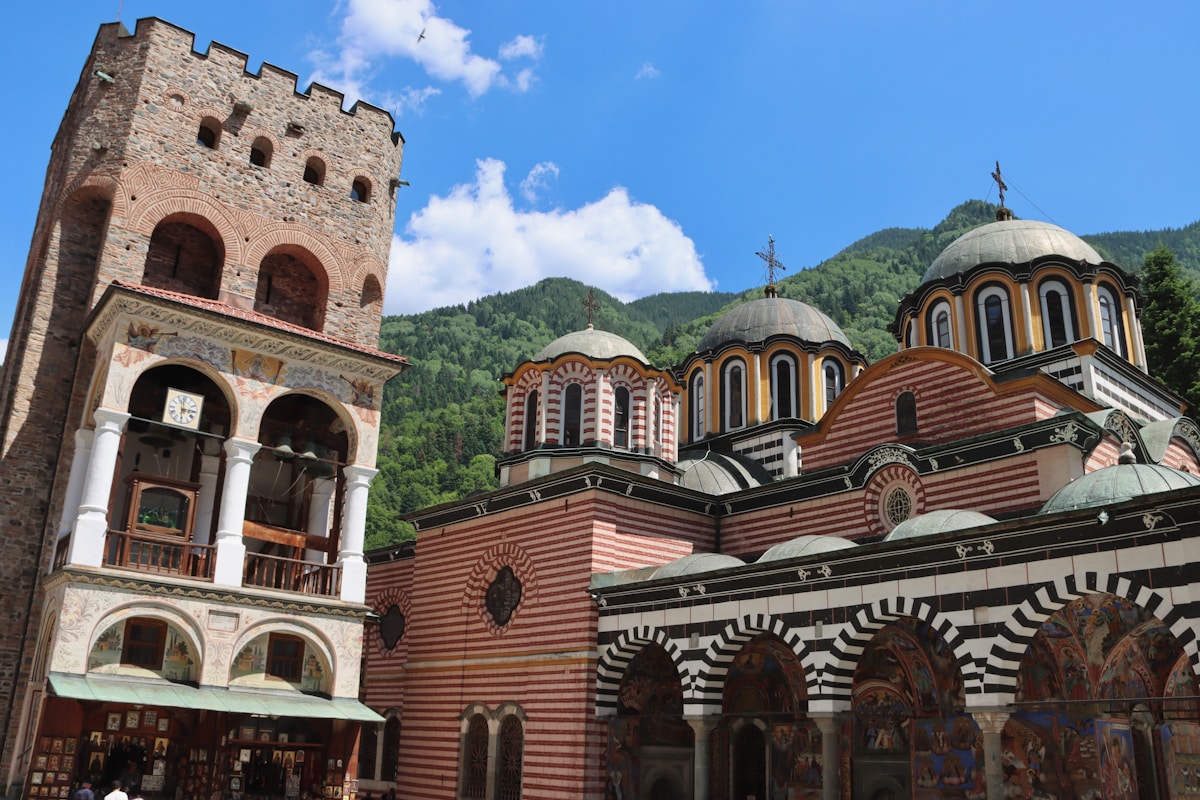
Rila Monastery — founded in the 10th century and the largest Eastern Orthodox monastery in Bulgaria — is a UNESCO World Heritage site and one of the most architecturally striking complexes in the Balkans. The striped arches of the main church, the medieval Hrelyo Tower, and the National Revival frescoes are extraordinary. It can be visited as a day trip from Sofia or combined with overnight stays in the Rila range.
Veliko Tarnovo — the medieval capital of the Second Bulgarian Empire — sits above a gorge of the Yantra River, with the Tsarevets Fortress illuminated each summer night by a light show. The old town, cobblestoned and descending steeply to the river, is one of Bulgaria’s most atmospheric urban landscapes.
The Thracian Tombs — scattered across the Stara Zagora and Kazanlak regions — are 4th–2nd century BCE burial mounds with intact frescoed chambers. The Kazanlak Tomb (UNESCO listed) is one of the most significant Thracian sites in the region.
Combining Bulgaria and Romania
The two countries share a long border and combine naturally in a two-to-three week trip. A logical route:
Fly into Sofia → Sofia (2–3 nights) → Plovdiv (2 nights) → Rila Monastery day trip → cross the Danube at Ruse-Giurgiu → Bucharest (2 nights) → Brasov (2–3 nights with Transylvania day trips) → Sibiu (1–2 nights) → fly home from Cluj-Napoca or Budapest
Alternatively, add Bulgaria’s Black Sea coast as a southern detour before crossing into Romania.
For the broader regional context, see our Balkans travel costs guide and the getting around the Balkans transport overview.
Related comparisons
- Serbia vs Romania — Romania’s south-western neighbour compared
- Sofia vs Belgrade — the two capitals side by side
- Balkans vs Greece — the broader region vs its most-visited southern neighbour
- Serbia vs Croatia — city culture vs Adriatic coast
- Albania vs North Macedonia — the western Balkans’ best-value pairing
- Bosnia vs Serbia — history, culture, and price across the border
See also: Serbia vs Romania · Sofia vs Belgrade · Balkans vs Greece · Balkans Comparison Guide
Plan your trip: Tours in Bulgaria · Tours in Sofia · Tours in Romania · Car hire · Travel insurance · eSIM · Search flights
🏨 Hotels in Sofia — Hotels in Bulgaria — Hotels in Romania — Hotels in Bucharest