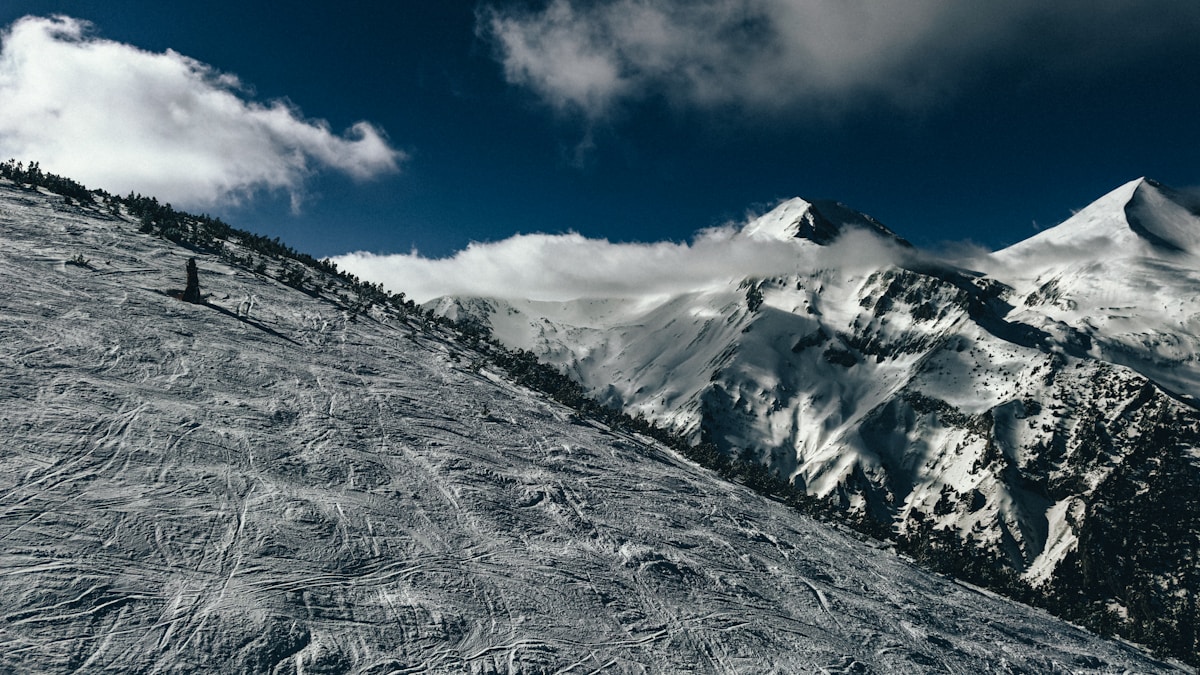
Bansko sits at the foot of the Pirin Mountains — a UNESCO World Heritage Site — and is the most developed ski resort in southeastern Europe. With 48 km of marked pistes reaching 2,600 m, a modern gondola system, reliable snowmaking, and one of the lowest week-cost ratios in Europe, it draws a mix of budget-conscious Western European skiers, experienced intermediates looking for uncrowded blacks, and beginners wanting proper ski school infrastructure at reasonable prices.
The resort has a significant advantage that most Balkans ski areas lack: an existing town with character. Bansko’s old quarter — cobbled lanes, stone-walled mehanas, 18th-century churches — means the après-ski and evening scene is genuinely good rather than a manufactured resort village. The gondola bottom station is about 4 km from the old town, connected by free ski buses throughout the day.
Piste Overview
The ski area spans from the gondola base station at Banderishka Polyana (1,700 m) up to 2,600 m above the treeline, covering three distinct terrain zones.
Beginner Terrain
The wide, gentle slopes directly around Banderishka Polyana are the resort’s best beginner area. The gradient is easy, the drag lifts are slow, and the area is separated enough from faster traffic that first-timers can find their feet without anxiety. The Plato run is the standard starting point — broad, well-groomed, and forgiving. Beginner lift passes cover just this lower section and cost significantly less than the full mountain pass.
Intermediate Terrain
The core of Bansko’s skiing lies between 1,700 m and 2,300 m — a mix of red runs through pine forest that are consistently groomed and varied enough to keep intermediate skiers engaged across a full week. The Tomba red run (named after the World Cup course that runs nearby) is the most popular cruise: long, well-pitched, and reliably pisted. Shiligarnika is a long blue-to-red descent that suits skiers building confidence. The forest setting on most of these mid-mountain runs provides shelter on windier days.
Key runs: Tomba (red), Shiligarnika (blue/red), Banderitsa (red), Platoto (blue).
Advanced Terrain
Above the treeline from 2,300 m to 2,600 m, the terrain opens into steeper, more exposed runs with genuine challenge. The World Cup Tomba black run — used for FIS competition — is a steep, mogul-heavy descent that rewards good technique. The Todorka sector offers the best off-piste potential, with untracked bowls on powder days. Off-piste skiing above the treeline requires awareness of avalanche risk; Bansko Freeride guides off-piste tours from approximately BGN 200 (€100) per half-day for groups.
Full Piste Stats
| Stat | Detail |
|---|---|
| Base altitude | 930 m (town), 1,700 m (gondola top) |
| Summit | 2,600 m |
| Total pistes | Approximately 48 km |
| Longest run | Approximately 16 km (top to town) |
| Lifts | 1 gondola, 6 chairlifts, 8 drag lifts |
| Snowmaking | Approximately 75% piste coverage |
| Season | Mid-December to mid-April |
Lift Passes
Passes are purchased at the gondola base station or online. Online pre-purchase occasionally offers a 5–10% discount and avoids queuing at the ticket office on busy mornings.
| Pass | Adult | Child (7–12) |
|---|---|---|
| 1 day | BGN 100–130 (€50–65) | BGN 55–70 (€28–35) |
| 3 days | BGN 260–340 (€130–170) | BGN 145–185 (€73–93) |
| 6 days | BGN 480–620 (€240–310) | BGN 265–340 (€133–170) |
Prices fluctuate between early season (December, start of January), peak (Christmas/New Year week, February half-term), and late season (March–April). Budget skiers should aim for early January or late March — snowpack is usually adequate and prices are at their lowest.
A beginner pass covering only the lower slopes and drag lifts is available at a reduced rate, typically around BGN 50–60 (€25–31) per day — worth asking about at the ticket office if you are just starting out.
Ski Schools and Instructors
Ulen Ski School is the primary operator and the most established in the resort. English-speaking instructors are the norm during peak weeks. Options:
- Group lessons: BGN 60–80 (€30–40) for a 2-hour session. Morning sessions (typically 10:00–12:00) are standard. Groups are split by ability — absolute beginners through to improvers.
- Private lessons: BGN 120–160 (€60–80) per hour. Private instruction is recommended for children under 8, for adults returning after a long gap, or for intermediates wanting to break into black run terrain.
- Children’s ski club: Ulen runs a structured programme for children aged 4–12 with dedicated instructors and a separate beginner area. Full-day programmes are available.
Alternatively, several independent instructors operate in the resort. They typically charge similar rates to Ulen but offer more flexible session timing. Your accommodation is usually the best source of recommendations for independent instructors.
Booking: During Christmas/New Year and February half-term, private lessons can fully book weeks in advance. Group lesson slots are more available but also fill quickly in peak weeks. Book before arrival if possible.
Ski Rental
Full ski equipment (skis, boots, poles) rents for approximately BGN 40–60 (€20–30) per day from shops near the gondola base. InterSport Bansko and Bansko Sport are the two main rental outlets; both have English-speaking staff, fitting services, and a range of quality from basic to high-performance carving gear. Snowboard equipment is similar pricing.
Multi-day rental at a fixed shop is cheaper than renting day-by-day — a 6-day rental typically costs the equivalent of 4–4.5 day rates.
Bansko vs the Alps: Cost Comparison
A week’s skiing in Bansko costs roughly 40–50% less than a comparable week in a mid-range Austrian or French resort.
| Cost (1 week, per person) | Bansko | Mid-range Alps |
|---|---|---|
| Lift pass (6 days) | €240–310 | €380–480 |
| Accommodation (7 nights) | €140–280 | €350–600 |
| Ski rental (6 days) | €120–180 | €180–280 |
| Food & drink (7 days) | €105–175 | €250–450 |
| Total estimate | €605–945 | €1,160–1,810 |
What Bansko lacks relative to major Alpine resorts: scale (48 km vs 200+ km in Trois Vallées or Ischgl), more consistent grooming on busy days, and the variety of terrain that only comes with a larger resort. What it has: genuine value, an atmospheric base town, and a longer season than most Alpine resorts at comparable altitude.
When to Ski: Month by Month
December (mid-month onwards): The season opens once snowmaking is complete. Lower slopes and gondola runs are ready; upper-mountain blacks may be patchy until January. Quietest period — prices are lowest and queues are short.
January: Best combination of snow depth and manageable crowds outside Christmas week. The snowpack builds through the month. Ski school availability is at its widest. The recommended month for a first trip to Bansko.
February: Peak snowpack. Best conditions across the full mountain. Also the busiest month — gondola queues can hit 40 minutes at 09:00 on a Saturday. Book accommodation and ski school slots weeks ahead for half-term.
March: Still good skiing, especially above 2,000 m. Temperatures warm enough to ski in a mid-layer on sunny afternoons. Increasingly quiet after the first week; accommodation rates drop. Lower runs begin to thin out by late March.
April (early): Upper mountain runs at 2,300–2,600 m typically hold snow into the first two weeks of April. A niche but worthwhile option for experienced skiers who want uncrowded blacks and spring sun.
Getting There from Sofia
Bus: The most common option. Direct buses from Sofia Central Bus Station to Bansko take approximately 2.5–3 hours and cost around €8–12 return. Multiple departures daily during ski season; fewer in off-season.
Car: Via the E79 motorway south through the Struma valley, approximately 2–2.5 hours (roughly 160 km). Parking in Bansko is available at most hotels and in public car parks near the old town (approximately BGN 5–10 / €2.50–5 per day).
Airport transfer from Sofia (SOF): Shared shuttle transfers run directly from Sofia airport to Bansko accommodation, taking approximately 2–2.5 hours and costing around €20–30 per person. Private transfers cost approximately €80–120 for the vehicle. Book a transfer from Sofia Airport to Bansko — most operators run this as a fixed route with set departure times.
From Plovdiv: By bus approximately 3–3.5 hours (change at Septemvri or direct on less-frequent services). Approximately €10–14.
On the Mountain: Practical Details
- Free ski bus: Runs from the old town to the gondola base station throughout the ski day. Frequency increases at peak times (08:00–09:30 and 15:30–17:00).
- Gondola hours: Typically 08:30–17:00 on the main line. Chairlifts may close slightly earlier in poor visibility.
- Gondola queues: At Christmas and in February, the morning gondola queue can be 30–45 minutes. To avoid: be at the base by 08:15, or ski mid-mountain on chairlifts only during peak morning hours.
- Currency: All lift passes and ski rental can be paid in Bulgarian lev (BGN) or euros. Cards are widely accepted.
After Skiing
Bansko’s après-ski starts near the gondola base: Happy End and BPD Bar fill from 16:30 during peak weeks. In the evening, the old town’s mehanas are the main draw: traditional Bulgarian food, live folk music, and cheap wine by the carafe.
Mehana Baryakova and Mehana Kasapinova are the most traditional options — expect kapama stew, grilled pork ribs, and shopska salad for approximately BGN 14–25 (€7–13) per main. The hot springs at Banya (5 km from town) and Dobrinishte (6 km south) are worth an evening visit — outdoor mineral pools at 36–42°C, entry approximately BGN 5–8 (€2.50–4).
See Also
- Bansko travel guide
- Things to do in Bansko
- Where to stay in Bansko
- Skiing in the Balkans
- Bansko vs Borovets
- Bulgaria travel guide
- Balkans in January
- Balkans in February
- Sofia travel guide
Plan your trip: Browse ski lessons and activities in Bansko — Ulen Ski School slots, guided off-piste tours, and snowshoeing are all bookable in advance. Book a transfer from Sofia to arrive directly at your hotel. Cover your trip with winter sports travel insurance — standard policies exclude skiing; make sure yours doesn’t.