Croatia is the Balkans’ best-known destination, and for a first visit the classic south-to-north (or north-to-south) corridor covers the essential range: the Central European sophistication of Zagreb, the waterfalls of Plitvice rising from forested gorges, the Roman street grid of Split behind its Diocletian Palace walls, and the impossible beauty of Dubrovnik from the sea. This is a first-timer’s best-of - not a coastal driving route (see the Croatian Coast Road Trip for that). All prices in euros (€); estimates are.
Overview
| Day | Area | Key activities |
|---|---|---|
| 1 | Zagreb | Upper Town, St Mark’s, Dolac Market |
| 2 | Zagreb | Lower Town museums, Maksimir Park |
| 3 | Plitvice Lakes | Lower Lakes, Veliki Slap waterfall |
| 4 | Split | Diocletian’s Palace, Marjan Hill |
| 5 | Split | Trogir day trip, Klis Fortress |
| 6 | Dubrovnik | Old town walls, cable car |
| 7 | Dubrovnik | Lokrum Island, departure |
Day 1 - Arrive Zagreb: Upper Town and Dolac Market
Arrive at Zagreb Franjo Tuđman Airport (ZAG). Bus 290 (Pleso Prijevoz) connects the airport to the main bus station (approximately €7, 40–50 min). Taxis cost approximately €30–40 and take 20–30 min. From the bus station, tram lines 2, 6, and 31 reach the centre.
Zagreb’s Upper Town (Gornji Grad) is the medieval hilltop core - a neighbourhood of baroque churches, galleries and government buildings above the commercial lower town. The funicular (uspinjača, approximately €0.50) rises from Ilica Street to Strossmayer Promenade in 1 minute and has run since 1890.
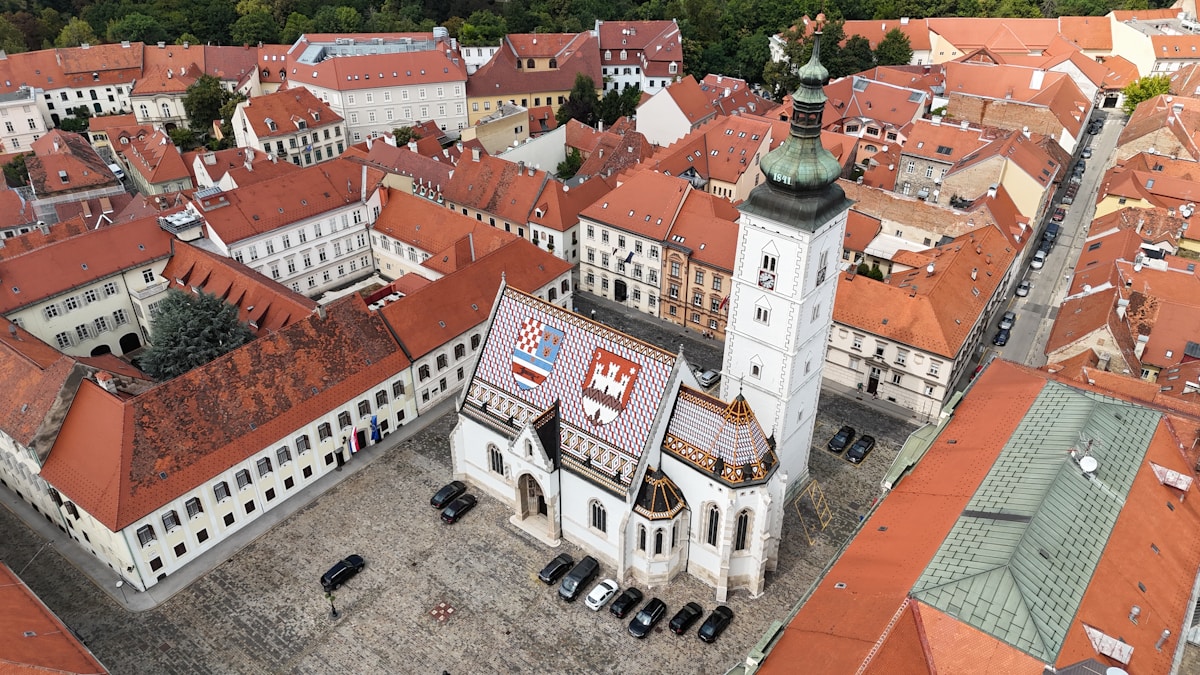
St Mark’s Church (free, open to visitors outside Sunday masses) is Zagreb’s most recognisable landmark: a Gothic church with a 13th-century nave and a roof tiled in 1882 with two coats of arms - the historic Croatian–Dalmatian–Slavonian arms on the left and the Zagreb city arms on the right - arranged in vivid geometric coloured tile.
Walk through Kamenita Vrata (Stone Gate) - the only remaining gate of the medieval town walls, now containing a small baroque shrine to the Virgin Mary, blackened by candle smoke and covered in ex-voto plaques from Zagrepčani.
Dolac Market (open daily until approximately 14:00, busiest 07:00–12:00) is the main open-air fruit, vegetable and flower market just below the Upper Town entrance - red and orange umbrellas over stalls of seasonal produce, cheese and flowers. Breakfast here from the bread and pastry stalls costs approximately €2–4.
Evening: Tkalčićeva Street is Zagreb’s best pedestrianised evening strip - a long alley of bar terraces from atmospheric old caffe bars to cocktail lounges. Dinner at Konoba Didov San (Dalmatian fish and lamb, approximately €18–28/person) or Lunch Room Pingvin (open until midnight, famous fish sandwiches from approximately €4–6).
Browse tours and activities in Zagreb →
Where to stay in Zagreb:
- Budget: Hostel Chillout Zagreb - dorm from approximately €18–24/night; central, walking distance from the Upper Town
- Mid-range: Hotel Jägerhorn - from approximately €85–130/night; the oldest hotel in Zagreb (1827), beside the Stone Gate
- Upper: Esplanade Zagreb Hotel - from approximately €200–320/night; the iconic 1925 hotel built for the Orient Express route, with the legendary Zinfandel’s Restaurant
Search all Zagreb hotels → Full guide: where to stay in Zagreb
Day 2 - Zagreb: Lower Town museums and Maksimir
The Lower Town (Donji Grad) is a grid of 19th-century Austro-Hungarian boulevards planned by Milan Lenuci’s “Green Horseshoe” - a horseshoe of parks and squares lined with museums.
Croatian Museum of Arts and Crafts (approximately €5 entry, ul. Trg Republike Hrvatske 10) houses a strong collection of decorative arts, furniture and fashion spanning 600 years. Mimara Museum (approximately €7, Rooseveltov Trg 5) holds a vast private collection including old master paintings, glass, tapestries and oriental art - 3,750 pieces donated to the city by Ante Topić Mimara.
The Museum of Broken Relationships (Muzej prekinutih veza, approximately €5 entry, ul. Ćirilometodska 2) in the Upper Town has since spawned international exhibitions: a collection of objects donated by people who lost a relationship, each with a short explanatory label. Unexpectedly affecting. Allow 1 hour.
King Tomislav Square (Trg Kralja Tomislava) is Zagreb’s grandest public space - the equestrian statue of Croatia’s first king at the lower end of a formal park lined with the Art Pavilion (temporary exhibitions, approximately €5) at the south end.
Afternoon: tram to Maksimir Park (Tram 11 or 12, free park entry) - a large English-style landscape park established in 1794, Zagreb’s green lung. The small Maksimir Zoo inside the park charges approximately €10. The park itself is free and popular with families and joggers.
Evening: the Advent in Zagreb (late November to early January) transforms the city with one of Europe’s most-awarded Christmas markets. Outside this period, Craft Beer Bar Zagreb (Varsavska 6) has the best tap selection in the city.
Eat in Zagreb: Best restaurants in Zagreb covers the full range. For a quick lunch: Vincek ice cream parlour on Ilica (Croatian gelato, approximately €2–3/scoop, open since 1972). Dinner: Bistro Fotić (seasonal Croatian cooking, approximately €20–32/person) or Mundoaka Street Food (creative street food format, approximately €10–16/person).
Day 3 - Plitvice Lakes National Park
Bus from Zagreb Main Bus Station to Plitvice (Autotrans, approximately every 2 hours, approximately €10–14, 2–2.5 hours). The bus stops at both Entrance 1 (Upper Lakes) and Entrance 2 (Lower Lakes) - get off at Entrance 2 for the classic lower lakes circuit.
Plitvice Lakes is Croatia’s most visited attraction and a UNESCO World Heritage Site since 1979: 16 terraced lakes connected by waterfalls, fed by the Crna and Bijela rivers over a travertine limestone karst plateau. Entry fees vary by season (approximately €10 in winter to €40 in peak summer); buy tickets online in advance for peak season (June–September) to guarantee entry - the park caps daily visitors.
Veliki Slap (Big Waterfall, 78 metres) is Croatia’s highest waterfall and visible from the main path - accessible in approximately 30 minutes from Entrance 1. The Lower Lakes circuit (Route C from Entrance 2, approximately 3–4 hours) is the most rewarding: boardwalks over turquoise water, short boat crossing on the electric-powered pontoon, and views from the Sastavci viewpoint where the main falls cascade into the Lower Lakes canyon.
Wear good walking shoes - the wooden boardwalks become slippery. The lower lakes are most impressive in spring (April–May, full snowmelt flow) and early autumn (September, before leaf fall and fewer crowds).
Eat near Plitvice: the park has overpriced cafeterias; pack lunch or eat at Restaurant Lička Kuća (traditional Lika region food including lamb under the peka, approximately €16–24/person, 500m from Entrance 1).
Return bus to Zagreb (approx 2.5 hours) then overnight bus to Split (Flixbus or Croatia Bus, approximately €15–22, 5–6 hours) or stay one night near Plitvice and take the morning bus to Split directly (also approximately 4.5–5 hours south).
Day 4 - Split: Diocletian’s Palace and Marjan Hill
Arrive Split (bus station is a 5-minute walk from the Diocletian’s Palace old town).
Split is unique among Mediterranean cities: an entire Roman palace became the city centre. Diocletian’s Palace was built between 295 and 305 CE as a retirement complex for the Emperor Diocletian - a walled compound measuring 215×175 metres with towers, gates, and an imperial mausoleum. In the 7th century, refugees from the nearby Roman city of Salona moved inside the walls, and their descendants have lived here ever since. The palace is not a museum - it is a living neighbourhood of cafés, restaurants, apartments and churches inside Roman walls.
Key sites inside the palace:
- Peristyle (the central colonnaded courtyard) - free to view
- Cathedral of Saint Domnius (the converted mausoleum, approximately €5 for cathedral + crypt; approximately €8 to climb the Romanesque campanile for city views)
- Vestibule (the roofless domed entrance hall to the imperial apartments) - free
- Temple of Jupiter (now a baptistery, approximately €3 entry)
Afternoon: walk or take the local bus up to Marjan Hill (Šuma Marjan) - a forested peninsula west of the old town with 3.5 km of coastal walking paths and views from the summit (178m) over the Adriatic and the Brač island profile. Free. The descent east leads to Meštrović Gallery (approximately €10 entry) - the atelier and museum of Ivan Meštrović, Croatia’s greatest sculptor, whose monumental bronzes fill the terraced villa he built in 1931.
Evening: dinner on the Riva (Split’s seafront promenade) or inside the palace. Konoba Matejuška (fresh fish, approximately €20–30/person) in the Varoš fishing quarter above the Riva is the best local fish option.
Book tours and activities in Split →
Where to stay in Split:
- Budget: Hostel Emanuel - dorm from approximately €22–32/night; inside the palace walls
- Mid-range: Hotel Vestibul Palace - from approximately €130–190/night; converted Roman chambers inside the palace
- Upper: Le Méridien Lav Split - from approximately €200–350/night; 6 km south of the old town, beach access
Search all Split hotels → Full guide: where to stay in Split
Day 5 - Split: Trogir and Klis Fortress
Bus or catamaran to Trogir (Bus Line 37 from Split, approximately €2.50, 30 min; or taxi approximately €25). Trogir is a small island city accessible by bridge, with a medieval UNESCO-listed old town: the Cathedral of St Lawrence contains the Romanesque Portal of Master Radovan (1240), the most celebrated medieval sculpture in Dalmatia. Cathedral entry approximately €5; campanile climb approximately €3.
Return to Split and take Bus 22 (approximately €2, 25 min) to Klis Fortress (entry approximately €8, open daily) - a medieval hilltop fortification 9 km north of Split used as both a Croatian royal stronghold and, for 101 years, an Ottoman border garrison. The Game of Thrones filming location for “Meereen” for those who care about that.
Evening: swim at Bačvice Beach (15 minutes’ walk from the old town) - a shallow sandy bay famous for picigin, a traditional ball game played chest-deep in the water.
Eat in Split: Best restaurants in Split covers the options. Quick choice: Uje Oil Bar (local olive oils, tapas, approximately €15–20/person) on Dominisova for lunch; Nostromo (fresh fish, approximately €25–40/person) for a final Dalmatian dinner.
Day 6 - Dubrovnik: Old Town Walls and Cable Car
Catamaran from Split to Dubrovnik (Jadrolinija or Krilo, 3 hours direct, approximately €25–35; book in advance in summer). The catamaran arrives at the Gruž harbour, a short bus or taxi ride from the old town. Alternatively, bus from Split (approximately €15–20, 4.5 hours, scenic coastal route).
Dubrovnik old town is enclosed by 1,940 metres of 13th–17th century walls - the most intact medieval city walls in Europe. Entry to walk the walls (approximately €35; buy online in advance) is best done early morning before the cruise ships arrive (walls open at 08:00; crowds peak 10:00–14:00). The walk takes 1.5–2 hours and offers views over the terracotta rooftops and the Adriatic from every angle.
Stradun (Placa) is the main limestone-paved street running the length of the old town - polished to a near-mirror shine by centuries of feet. The Onofrio Fountain at the western end (1438) and the Church of St Blaise at the eastern end mark the two ends of the Stradun procession.
Dubrovnik Cable Car (Žičara, approximately €25 return, station at Petra Krešimira IV street above the Pile Gate) runs to Mount Srđ (412m) in 4 minutes. The mountain was the site of the Croatian defensive position during the 1991–1992 Siege of Dubrovnik - the Museum of the Homeland War at the summit (approximately €8 entry) documents the siege with photographs, weapons and testimonies from defenders who held the hill through the shelling below.
Browse guided tours in Dubrovnik →
Where to stay in Dubrovnik:
- Budget: Old Town Hostel - dorm from approximately €35–50/night; inside the walls (rare to find budget beds inside the gates)
- Mid-range: Hotel Lero - from approximately €130–200/night; 10-minute walk from Pile Gate
- Upper: Hotel Excelsior - from approximately €350–600/night; cliff position with sea views, legendary address
Search all Dubrovnik hotels → Full guide: where to stay in Dubrovnik
Eat in Dubrovnik: Best restaurants in Dubrovnik has current recommendations. Nishta (vegetarian, one of the most beloved restaurants in the city, approximately €18–28/person) requires a reservation. Buffet Škola (simple Dalmatian food, approximately €8–15/person) on Antuninska is the cheapest good meal inside the walls.
Also see: food tours in Dubrovnik for a guided half-morning of the old town’s eating culture.
Day 7 - Dubrovnik: Lokrum Island and departure
Lokrum Island (ferries every 30–45 minutes from the old harbour, approximately €15 return, 15-minute crossing; seasonal service April–October) is a nature reserve island 600m offshore with no permanent inhabitants. A Benedictine monastery (ruins), botanical garden, peacocks roaming freely, a salt lake behind the rocks connected to the sea, and a Game of Thrones exhibit in the old fort. Allow 2–3 hours. No vehicles; no accommodation.
For those with a late departure flight: walk outside the Pile Gate to the Gradac Park area on the western cliff of the old town - one of the few free viewpoints looking back over the walls from the sea side.
Day trips from Dubrovnik can include the Elafiti Islands (boat tour, approximately €35–50), Montenegro’s Bay of Kotor (bus tours from approximately €35), or Mostar in Bosnia (bus tours from approximately €40). All depart from Gruž harbour or arranged through the old town agencies.
Dubrovnik Airport is at Čilipi, 22 km south. Atlas shuttle buses (approximately €10) run to the old town and Gruž harbour. Taxis cost approximately €35–50.
Transport summary
| Leg | Method | Approx. cost | Approx. time |
|---|---|---|---|
| Airport → Zagreb centre | Bus 290 | €7 | 45 min |
| Zagreb → Plitvice | Bus | €10–14 | 2–2.5 hrs |
| Plitvice → Split | Bus | €15–20 | 4.5–5 hrs |
| Split → Trogir | Local bus 37 | €2.50 | 30 min |
| Split → Klis | Local bus 22 | €2 | 25 min |
| Split → Dubrovnik | Catamaran | €25–35 | 3 hrs |
| Dubrovnik → Airport | Atlas shuttle | €10 | 35 min |
All costs are and may vary by season and operator.
Budget overview
| Category | Budget/day | Mid-range/day |
|---|---|---|
| Accommodation | €22–35 | €130–200 |
| Food | €20–30 | €40–65 |
| Transport | €5–12 | €10–20 |
| Sights/activities | €10–20 | €20–40 |
| Total | approx. €57–97 | approx. €200–325 |
Note: Dubrovnik days skew higher - budget approximately €50–60 extra on wall entry and cable car. The national park entry at Plitvice can be €35–40 in peak season.
Related Croatia and Balkans guides
- Zagreb travel guide
- Best restaurants in Zagreb
- Plitvice Lakes guide
- Split travel guide
- Best restaurants in Split
- Best tours in Split
- Dubrovnik travel guide
- Best restaurants in Dubrovnik
- Best tours in Dubrovnik
- Croatia travel guide
- Food tours in Dubrovnik
- Day trips from Dubrovnik
- Croatian Coast Road Trip itinerary
- 3 days in Dubrovnik
- Croatia ferry guide
- 2 weeks in the Balkans
Where to Stay
- Zagreb - Where to stay in Zagreb
- Split - Where to stay in Split
- Dubrovnik - Where to stay in Dubrovnik
Things to do at each stop:
Book Your Trip
Flights - search and compare on Aviasales · flights guide eSIM - stay connected with Airalo · eSIM guide Travel insurance - get covered with EKTA · insurance guide Airport transfers - book with Kiwitaxi Car rental - compare with GetRentaCar · car hire guide Hotels - compare and book accommodation on Booking.com Tours and activities - browse GetYourGuide