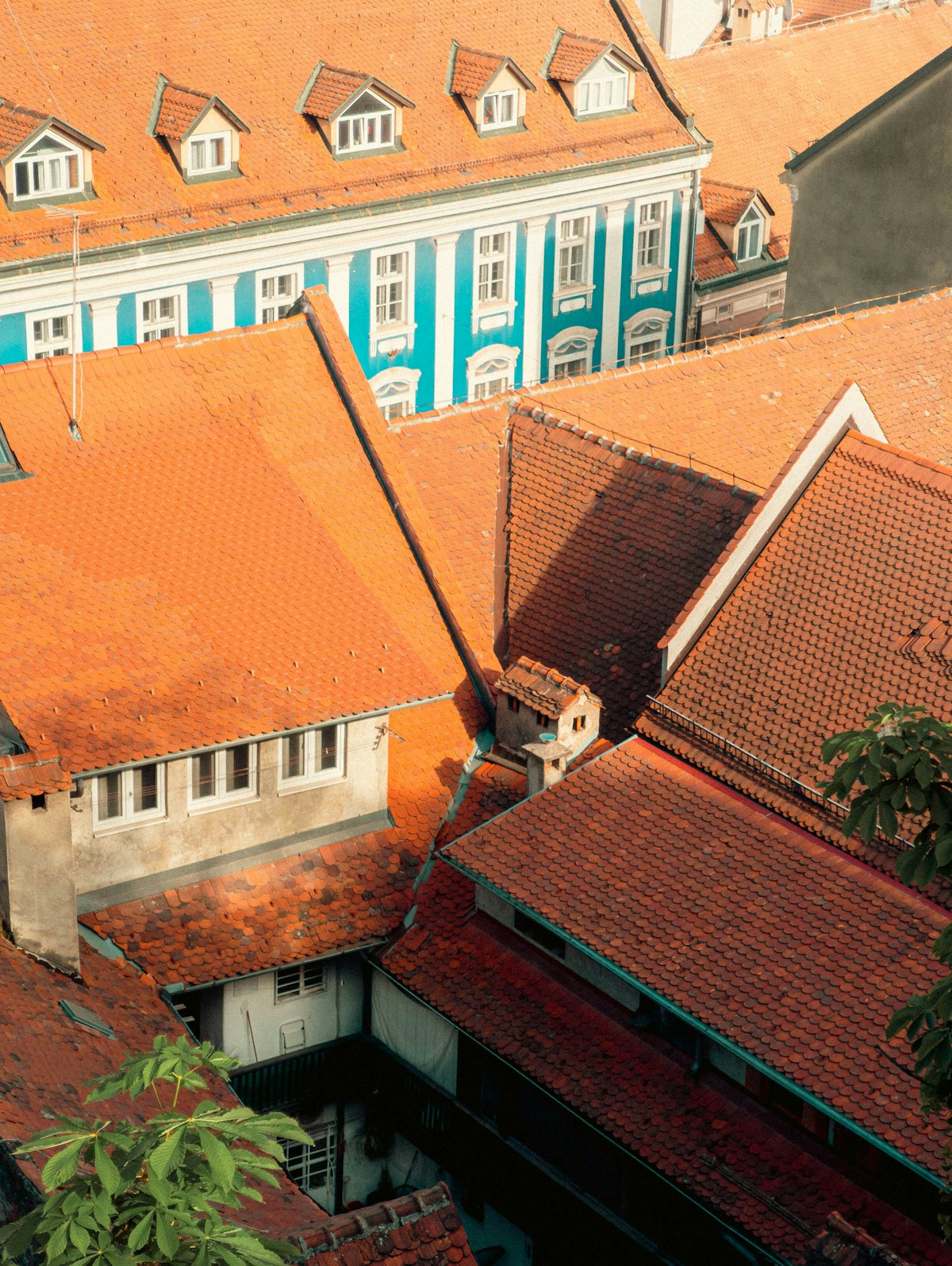
Zagreb’s attraction list is defined by its Upper Town (Gornji Grad), its market culture, and a collection of museums that range from serious history to the genuinely odd. It is a city for walking and discovering rather than ticking off a standard highlights list - but several specific sights are worth understanding before you arrive. All prices are in euros (€) and approximate as of 2026.
St. Mark’s Church (Crkva sv. Marka)
St. Mark’s Church in Gornji Grad is Zagreb’s most iconic image - a Gothic church whose roof was retiled in the 19th century with a polychrome mosaic showing the medieval coats of arms of Croatia, Dalmatia, and Slavonia on the left, and the arms of Zagreb on the right. The colour and pattern are visible from the square below and immediately recognisable.
The interior is quieter - painted decorations from the 20th century and an altar in the Croatian Art Nouveau style. The church is an active place of worship; check times before visiting if you want to see the interior.
Entry: Free. Location: Gornji Grad (Upper Town) - reach via funicular from Ilica Street or the stairways from Radićeva Street.
Museum of Broken Relationships
One of Zagreb’s most-visited and most-written-about attractions, the Museum of Broken Relationships (Muzej prekinutih veza) occupies a baroque palace in Gornji Grad and displays objects donated by people from around the world - each item from an ended relationship, accompanied by a written explanation. A toaster from a Berlin divorce. A prosthetic leg from a Bosnian war story. A garden gnome from London.
The concept sounds like a novelty and is experienced as something more. It is consistently rated among the top museums in Zagreb on every platform.
Entry: Approximately €7 for adults. Location: Ćirilometodska Street, Gornji Grad. Duration: Allow 60–90 minutes.
Ban Jelačić Square (Trg bana Jelačića)
The Ban Jelačić Square is Zagreb’s main public square - the focal point of city life and the junction between Gornji Grad (above) and Donji Grad (the Lower Town grid). The equestrian statue of Ban Josip Jelačić at the centre was removed during the Yugoslav period and restored in 1990. Tram lines converge here; the main city market (Dolac) is immediately above.
Entry: Free public space. Best time: Morning (for the market above), early evening (café terraces begin filling), December (Advent market).
Dolac Market
Dolac is Zagreb’s main food market, running on a raised terrace above Ban Jelačić Square on most mornings (typically 06:00–14:00, with variation by day). Fresh vegetables, fruit, cheese, eggs, and flowers fill the open stalls; an indoor section below the terrace sells meat and dairy.
It is a functioning city market rather than a tourist attraction - locals shop here, and the quality and variety are high. The surrounding streets have cheap breakfast spots and bakeries.
Entry: Free. Location: Above Ban Jelačić Square, accessible via short stairs from the square.
Lotrščak Tower (Kula Lotrščak)
The Lotrščak Tower (meaning Tower of the Captured Wind) is a 13th-century defensive tower at the southern tip of Gornji Grad. It offers the best panoramic view over the Lower Town and the city spread to the south. The tower’s most famous tradition: a cannon has been fired from it every day at noon since 1877, as a time signal for the city.
Entry: Approximately €2. View: Worth the climb - particularly good in the late afternoon light looking over the city roofscape. Location: Top of the funicular in Gornji Grad.
The Funicular (Uspinjača)
At 66 metres, the Zagreb Funicular is believed to be one of the shortest public funiculars in the world. It connects Ilica Street (Donji Grad) with Gornji Grad (Strossmayerovo šetalište), running since 1890. It is both a practical transport link and a Zagreb institution - riding it is part of the Upper Town visit.
Ticket: Approximately €0.66. Frequency: Every 10 minutes; journey time under 1 minute.
Mirogoj Cemetery
Mirogoj is Zagreb’s main cemetery and one of the most architecturally impressive in Central Europe - entered through a series of ivy-covered neoclassical arcades designed by the Croatian architect Hermann Bollé in 1876. Inside, it is a landscaped park of avenues, elaborate family mausoleums, religious chapels (Catholic, Orthodox, Jewish, and Muslim sections co-existing in a single space), and some extraordinary funerary sculpture.
Mirogoj is frequently cited as one of the most beautiful cemeteries in Europe. It is an active cemetery and a place of genuine pilgrimage for Croatian families, but it is also freely accessible to visitors.
Entry: Free. Transport: Tram 106 from the Cathedral, or tram 14 from the city centre. About 20–25 minutes from Ban Jelačić Square. Duration: Allow 60–90 minutes for a thorough walk through the main arcaded sections.
Zagreb Cathedral (Katedrala Uznesenja)
The Cathedral of the Assumption of the Blessed Virgin Mary (Zagreb Cathedral) is the tallest building in Croatia - its twin neo-Gothic spires (108 m each) are visible from across the Lower Town. Built on a site used for religious purposes since the 12th century and extensively reconstructed after an 1880 earthquake, the current cathedral is primarily the 19th-century Gothic Revival design by Hermann Bollé.
Entry: Free. Location: Immediately northeast of Dolac Market and Ban Jelačić Square.
Strossmayer Promenade
The Strossmayer Promenade (Strossmayerovo šetalište) runs along the southern edge of the Gornji Grad hill and offers the best sustained views over the city from above. The wide, tree-lined walkway is a popular spot for morning runs and evening walks. A small statue of Antun Gustav Matoš sits on a bench near the midpoint - a favourite photo spot.
Entry: Free public walkway.
Zagreb Street Art
Zagreb has a growing street art scene, concentrated in certain Lower Town neighbourhoods - particularly around Medvedgrad and the streets southeast of Dolac Market. Not a formal attraction but worth looking for while walking between sights.
Advent in Zagreb (December Only)
If you are in Zagreb in December, the Advent in Zagreb Christmas market deserves special mention. The city transforms multiple squares - Ban Jelačić Square, Zrinjevac Park, Strossmayer Square, and the area below Lotrščak Tower - with market stalls, ice rinks, mulled wine, and decorated lights. It has won Europe’s best Christmas market award several years running. The city fills considerably during this period - book accommodation early if visiting in December.
For full transport and logistics, see the Zagreb travel guide. For eating and restaurants, see our Zagreb restaurants guide.
See also
- Zagreb city guide
- Where to stay in Zagreb
- Best restaurants in Zagreb
- Food to try in Zagreb
- Croatia travel guide
- Croatian coast road trip
- Belgrade vs Zagreb
- Ljubljana vs Zagreb
- Balkan city breaks
Plan your trip: Book tours and activities in Zagreb - guided options cover everything from history walks to day trips. Pick up a Balkans eSIM for data on arrival, and protect your trip with travel insurance.