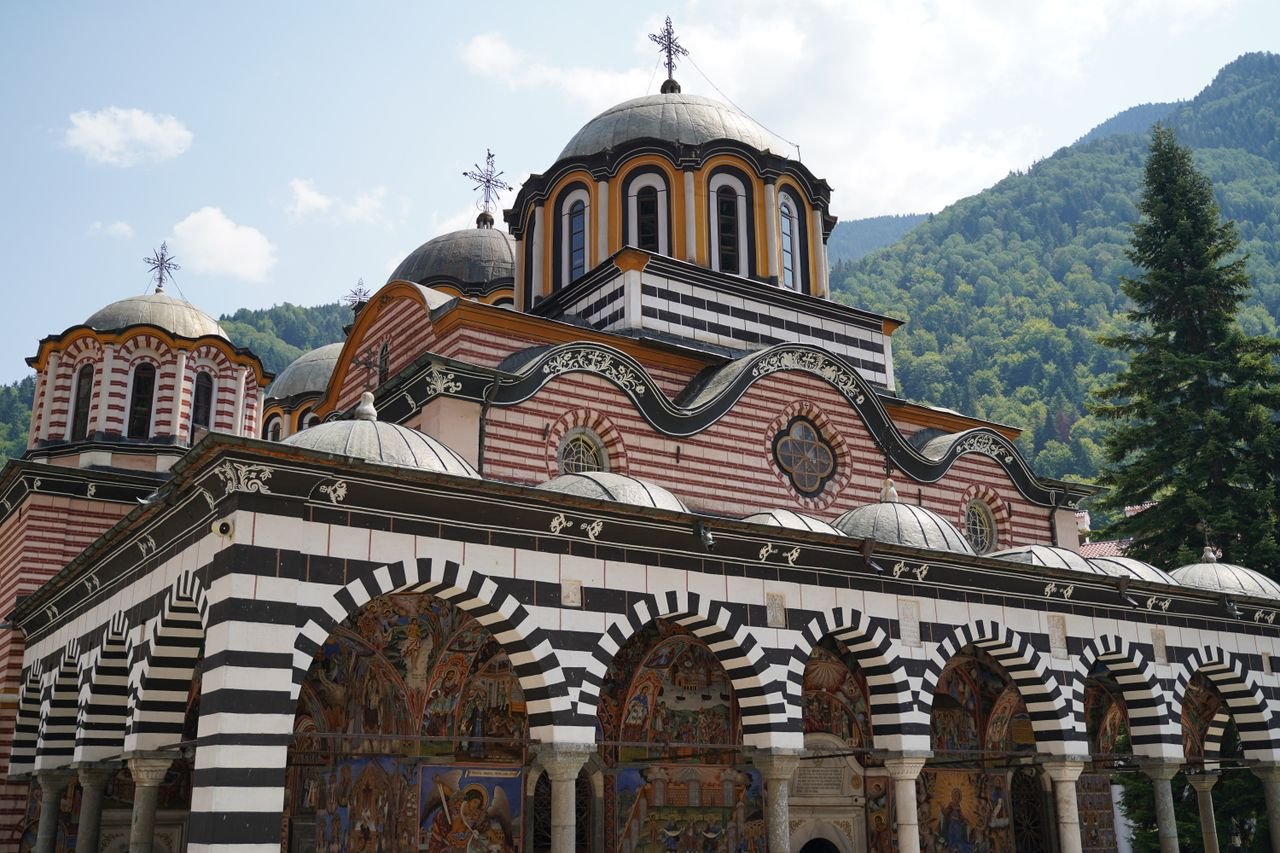
Rila Monastery is the most visited historic site in Bulgaria and the one most people mean when they say “day trip from Sofia”. It sits at about 1,150 metres in a forested valley of the Rila mountains, roughly 120 km south of the capital, and it is a UNESCO World Heritage Site. The complex looks far older than it is: after a fire in 1833 the monks rebuilt it almost entirely, and what you walk through today is a National Revival masterpiece of striped stone arcades, carved wooden balconies and a church covered in frescoes. This guide covers what to see, what to wear, and whether to take the bus or a tour. For the wider picture, see our best day trips from Sofia.
What to see at Rila Monastery
The monastery was founded in the 10th century by the hermit Saint Ivan of Rila, who is buried in the church. Four things deserve your time:
- The main church (Nativity of the Virgin). Built between 1834 and 1837, it has an outer porch painted with vivid scenes of saints, devils and the Last Judgement, and a gilded iconostasis inside. The frescoes continue across the interior walls and domes.
- Hrelyo’s Tower. The stone tower dates from 1335 and is the only medieval structure to survive the 1833 fire. It stands in the courtyard next to the church.
- The museum. It holds the Rafail Cross, carved by a monk over many years from a single piece of wood and said to contain more than 1,000 tiny figures. Bring good light and patience, since the detail is only visible up close.
- The courtyard and bakery. Four wings of arcaded galleries rise around the church. Just outside the main gate, locals queue for fresh mekitsi (fried dough) and banitsa, a cheap and sensible lunch.
If you have time, walk up to the cave of Saint Ivan of Rila, the hermit’s refuge on the path above the monastery. It is a short forest walk and usually much quieter than the courtyard.
Entry, hours and dress code
Entry to the monastery grounds and church is free. The museum costs approximately BGN 8 (about EUR 4) as of 2026. The monastery opens early and closes at dusk, with the museum open during daytime hours only, so confirm times on the official monastery website before you go. Information on its heritage status is on the UNESCO World Heritage page.
Dress as you would for any Orthodox church: shoulders and knees covered, no hats inside, and no photography in the church interior. Women often carry a light scarf for the porch. Visitors should speak quietly, because this is a working monastery with resident monks.
Sofia to Rila Monastery: bus vs tour
Guided tour. This is the simplest way. A day tour from Sofia typically costs approximately EUR 30-50 per person, covers transport and a guide, and often stops at Boyana Church on the way back. The Rila Monastery and Plovdiv full-day trip combines the monastery with Plovdiv’s old town in one long day, which suits travellers with limited time. See all Sofia tours on GetYourGuide for monastery-only options.
Public bus. Coaches run from Sofia to the monastery or to Rila village, a journey of about 2 to 3 hours. Fares run roughly EUR 8-15 each way. Services are few, usually a morning departure and an afternoon return, and timetables change between seasons. If your bus stops in Rila village rather than at the monastery, a local bus or taxi covers the remaining 22 km. Check a ticketing site for the current schedule the day before.
Self-drive. The monastery is approximately 120 km from Sofia, about 2 hours via the A3 motorway and Blagoevgrad. Parking at the monastery is available for a few leva. Driving also lets you stop in Rila village without a tour schedule.
Aim to arrive before 10:00 or after 15:00 in July and August, when tour coaches fill the courtyard, and weekdays are calmer than weekends.
Combining Rila Monastery with the Seven Rila Lakes
Visitors often ask about doing both in a day. We do not recommend it. The Seven Rila Lakes are reached from the Panichishte chairlift side of the range, and the loop trail alone takes 3 to 4 hours above 2,100 metres. Both together would mean 5 hours of driving plus a rushed visit to each.
Better options:
- Two separate days from Sofia. Take a monastery tour one day and the Seven Rila Lakes full-day hiking tour on another. The lakes tour includes transport and a guide, which helps in cloud when trail markings are unclear. The lakes are best from late June to September.
- Overnight in the area. Staying in or near Rila village lets you see the monastery after the day-trippers leave and start early for the lakes. Compare stays in Sofia if you prefer to return to the city each night.
- Add Plovdiv instead. If you want variety rather than hiking, pair the monastery with Plovdiv via the combined tour above, then read our Sofia things to do guide for what else to fit in.
Planning tips
- Best season: May to October. Snow can close the mountain road in winter, but the monastery looks striking dusted white and is open all year.
- Cash: carry leva for the museum, bakery and parking, as small shops do not always take cards.
- Weather: the valley is cooler than Sofia by several degrees. Bring a layer even in summer.
- Time budget: 2 hours on site, plus travel. A full tour day is typically 9 to 10 hours.
For a full route that places the monastery among Sofia, Plovdiv and the Black Sea, see our Bulgaria 7-day itinerary, and consider travel insurance if you plan to hike in the mountains.