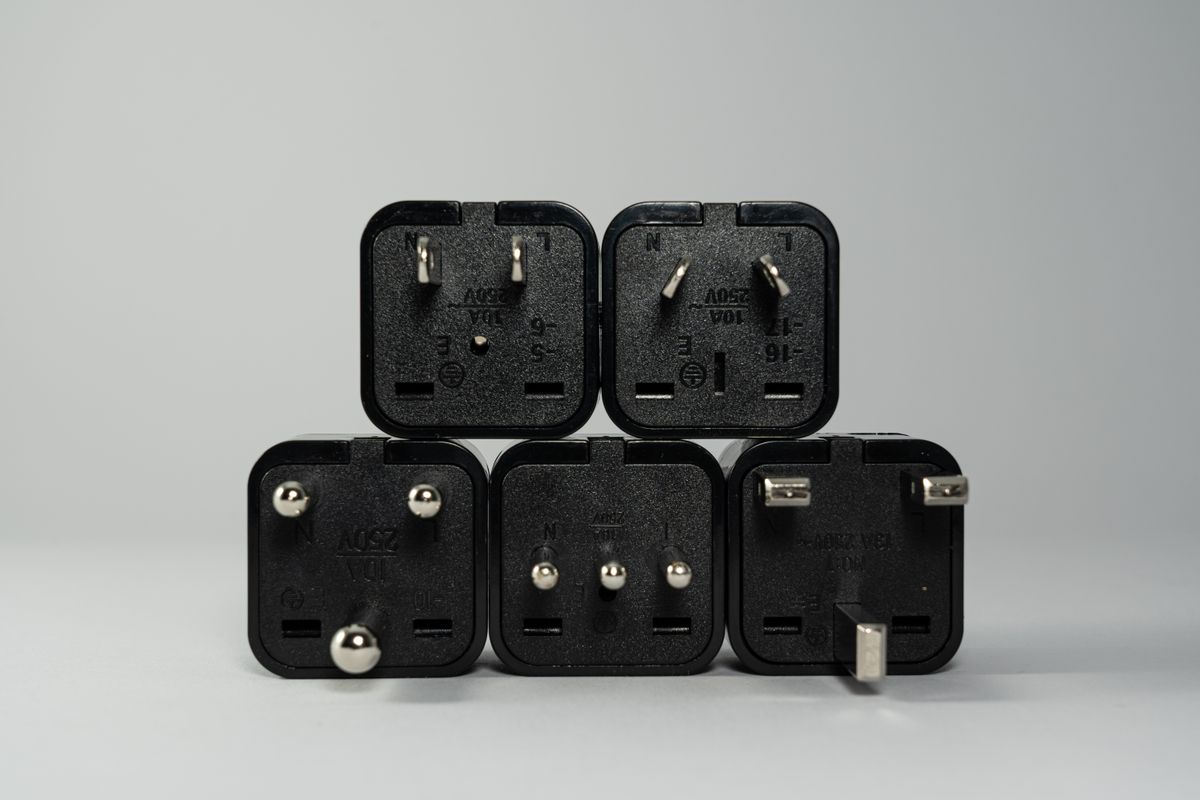
Packing for the Balkans is easy on power: the whole region shares one plug standard and one voltage, so a single adapter works from Ljubljana to Skopje. The details that catch people out are the plug type your devices actually need, the difference between an adapter and a converter, and a handful of local quirks in older guesthouses and mountain lodges. This page covers all of it so you can check one line off your Balkans packing list.
Plug types and voltage by country
Every country in the Balkans uses Type C and Type F sockets, with 230V at 50Hz. Type C is the slim two-round-pin Europlug. Type F is the same two pins with earthing clips on the sides, commonly called Schuko. Both plugs fit a Type F socket, and a Type C Europlug also fits most recessed Type F sockets.
| Country | Plug types | Voltage | Frequency |
|---|---|---|---|
| Croatia | C, F | 230V | 50Hz |
| Slovenia | C, F | 230V | 50Hz |
| Serbia | C, F | 230V | 50Hz |
| Montenegro | C, F | 230V | 50Hz |
| Bosnia and Herzegovina | C, F | 230V | 50Hz |
| North Macedonia | C, F | 230V | 50Hz |
| Albania | C, F | 230V | 50Hz |
| Kosovo | C, F | 230V | 50Hz |
If you are arriving from mainland Europe, you need nothing. If you are crossing several borders on a Balkans road trip, you also need nothing extra, because the standard never changes.
Which adapter to pack
- UK and Ireland (Type G): pack a G-to-C/F adapter. Type G plugs have three rectangular pins and will not fit at all.
- USA and Canada (Type A/B): pack an A/B-to-C/F adapter, and check voltage as explained below.
- Australia and New Zealand (Type I): pack an I-to-C/F adapter. Voltage matches, so no converter is needed.
- South Africa (Type M/N): bring a Europlug adapter. Many South African sockets already accept Type C.
- Most of Asia and the Middle East: a universal multi-plug adapter is the safest choice.
A compact universal adapter with USB-A and USB-C ports is the most useful option. It lets you charge a phone, earbuds and a camera battery from one socket, which matters in older apartments with only one outlet per room. Buy before you fly: airport kiosks in Belgrade, Zagreb and Dubrovnik sell adapters at a premium, often 8 to 15 EUR for a basic model, as of 2026. Electronics shops in city centres sell plain Europlug adapters for a few euros.
Adapter versus converter
An adapter changes the shape of the plug. A converter or transformer changes the voltage. In the Balkans you almost never need a converter, because phones, laptops, tablet chargers, camera chargers and e-reader chargers are designed for 100-240V.
Read the small print on the charger. If it says “Input: 100-240V”, you only need a plug adapter. If it says “120V” only, as many US hair dryers, curling irons, travel kettles and electric shavers do, it is not safe on 230V. Plugging it in can destroy the device or trip the fuse. Either buy a cheap local dryer in a Zagreb or Tirana pharmacy or drugstore, or ask your accommodation, as most hotels and many apartments supply hair dryers.
What to expect in hotels, hostels and apartments
Modern hotels in Dubrovnik, Split, Belgrade and Ljubljana have bedside sockets and often USB ports. Expect the opposite in older guesthouses and village rooms in Albania, Bosnia and rural Montenegro, where there may be one socket per room, loose or worn sockets, and sockets placed far from the bed.
Practical fixes we recommend:
- Bring a short extension lead or multi-way adapter so you can charge several devices from one socket.
- Pack a 2 metre phone cable, since sockets are often behind furniture.
- Check whether your room uses a key-card power switch, common in mid-range hotels. Power turns off when you remove the card, so phones will not charge while you are out. Slide a spare card, a loyalty card or a similar-sized piece of card into the slot if the property allows it.
- On ferries and buses, USB ports are inconsistent. Ferries between Split and the islands rarely have working sockets for passengers, so fully charge beforehand.
Power cuts and mountain areas
Outages are short but real. They are most common in rural Albania, in the Accursed Mountains around Theth and Valbona, in the Durmitor and Prokletije areas of Montenegro, and during heavy summer thunderstorms along the Adriatic coast. Mountain huts and guesthouses may run on limited generators or solar panels, with charging only at certain hours.
If you are trekking, carry a power bank of at least 10,000 mAh, a charging cable per device and a head torch. Power banks over 100Wh are restricted on aircraft, and spare lithium batteries must travel in hand luggage, not checked bags. Confirm the airline’s limit before you fly.
Staying connected without hunting for sockets
Charging is only half the issue. Many travellers burn through battery using maps and data abroad. Setting up a local plan avoids roaming charges and keeps you off hotel Wi-Fi for navigation; our Balkans eSIM guide compares the options, and you can get a Balkans eSIM before you land. If you are stopping in Croatia on the way, a Dubrovnik city walls tour is a long, sunny, phone-heavy day, so charge fully before you go.
Quick checklist
- One Type C/F adapter, or a universal adapter, for your home plug type.
- Check that every charger says 100-240V.
- Leave single-voltage hair dryers and kettles at home.
- Pack a power bank, a short extension lead and a long cable.
- Charge everything fully before hikes, island ferries and long bus rides.
With those five items packed, power will be one of the least stressful parts of a Balkans trip.