Thessaloniki packs an extraordinary density of historical layers into a walkable city core. Roman monuments, Byzantine churches, Ottoman mosques-turned-museums, and a Jewish heritage trail all sit within a few kilometres of each other along a spectacular waterfront. This guide covers the top things to do in Thessaloniki, organised by area, with entry prices current as of 2026 and honest time estimates.
Browse guided tours and walking tours in Thessaloniki if you want an expert-led introduction to the Byzantine or Roman layers — local guides add context that no audio tour replaces.
The Waterfront (Thermaic Gulf)
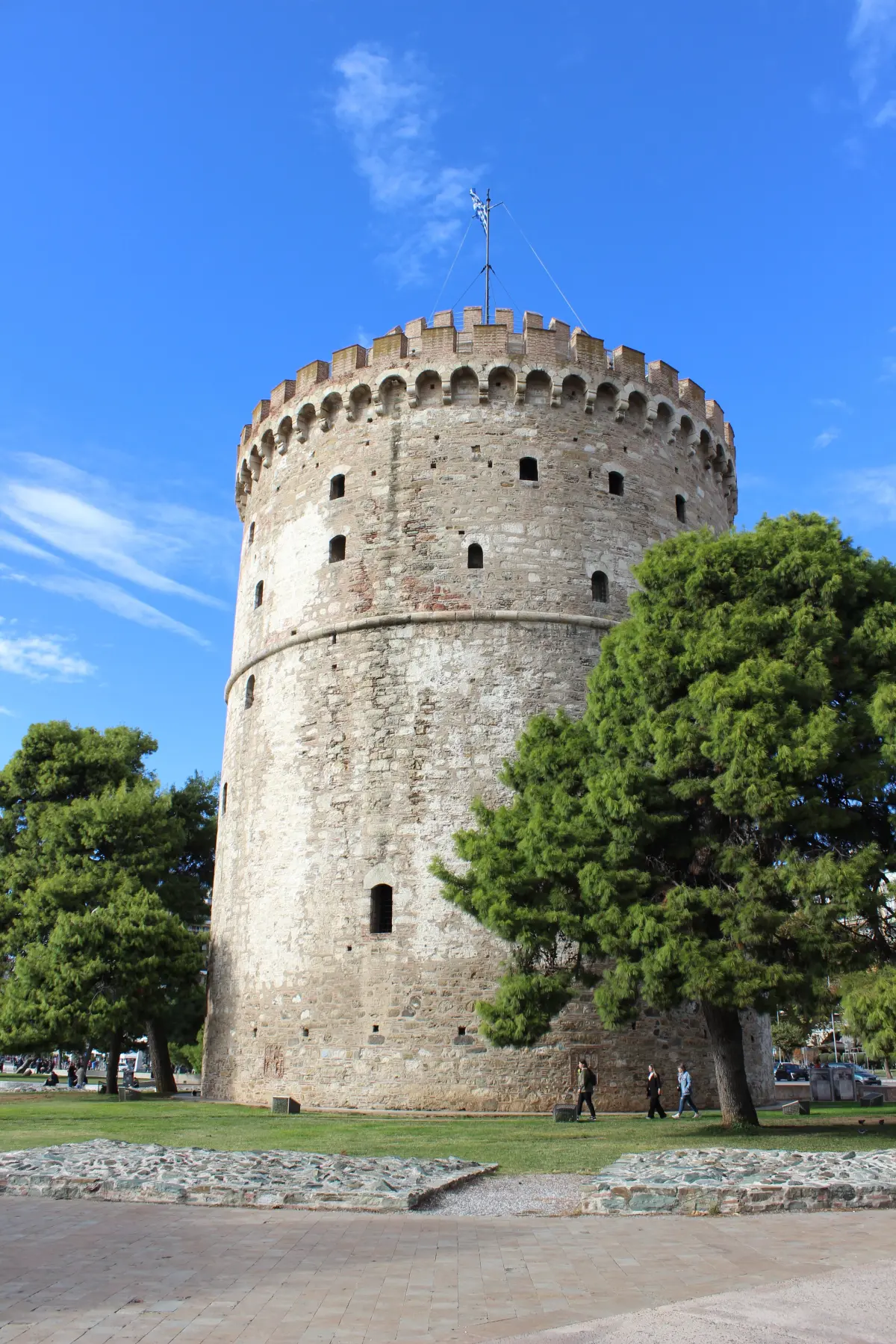
White Tower
Thessaloniki’s defining landmark and the most-visited site in the city. The 15th-century Ottoman fortification stands directly on the waterfront promenade and houses a permanent multi-floor exhibition tracing Thessaloniki’s history from ancient Macedonian times through the Byzantine and Ottoman periods. Entry is approximately €4 (as of 2026). The view from the roof over the Thermaic Gulf and the city — with Mount Olympus visible on clear days to the south — is the best vantage point in Thessaloniki. Allow 45–60 minutes for the interior exhibition plus roof. The promenade immediately north and south of the tower is pleasant for an evening walk regardless of whether you go in.
Aristotelous Square and Seafront Promenade
Aristotelous Square is the formal civic heart of the city — a wide neoclassical piazza designed by French architect Ernest Hébrard in the 1920s rebuild following the catastrophic 1917 fire. The colonnaded arcades frame a direct axis down to the sea. The cafes along the square are on the expensive side but the setting justifies it for a coffee. The waterfront promenade itself runs for several kilometres in both directions from Aristotelous; the section from the White Tower north to the Rotunda area is the most animated in the evenings, with locals walking, cycling, and gathering at outdoor bars. Entry free.
Archaeological Museum of Thessaloniki
One of the two or three best archaeological museums in Greece, and the best place to understand the ancient Macedonian world before visiting Vergina. The collection includes gold funeral wreaths of extraordinary craftsmanship, full sets of bronze armour, ivory-inlaid furniture fragments, and grave goods from the royal Macedonian tombs at Vergina and surrounding sites. Entry approximately €8 (as of 2026). The museum sits at the eastern end of Thessaloniki’s main park, about 10 minutes’ walk from the waterfront. Allow a minimum of 2 hours; serious history visitors will want 3. The museum is partly air-conditioned, making it a useful midday refuge in summer.
Museum of Byzantine Culture
Widely regarded as the best Byzantine art museum in Greece — some argue in the world — with 11 galleries covering Early Christian, Byzantine, and post-Byzantine artefacts: mosaics, frescoes removed from collapsed churches, jewellery, ecclesiastical metalwork, and painted icons. Entry approximately €8 (as of 2026). Located adjacent to the Archaeological Museum. Combined visits to both museums take a full morning or afternoon. The Early Christian gallery (Gallery 1) is the most visually striking starting point.
The Roman Layer: Galerius Complex
Arch of Galerius (Kamara)
The triumphal arch erected around 298 AD to celebrate Emperor Galerius’s defeat of the Persian Sassanid Empire. Two of the original four piers survive. The carved relief panels — showing the Roman campaign in extraordinary narrative detail: cavalry charges, siege warfare, the emperor receiving tribute — are some of the finest Roman sculptural carving in the eastern Mediterranean. Entry is free; the arch stands in the open street. The Kamara neighbourhood around it (named after the arch) is the best area in the city for coffee shops and bars, with a younger, less tourist-facing crowd than the waterfront.
Rotunda (Galerius Rotunda)
The single most historically layered building in Thessaloniki. The circular brick structure was built around 300 AD as a mausoleum for Emperor Galerius. It was converted into a Byzantine church in the 4th century — the mosaics installed at that point, depicting saints and architectural fantasies in gold tesserae, survive in fragmentary but stunning condition on the dome interior. During the Ottoman period it became a mosque; the minaret still stands attached to the exterior. Entry approximately €4 (as of 2026). Do not miss the mosaic panels inside; photography is permitted. Allow 30–40 minutes.
Palace of Galerius
Scattered remains of the 4th-century imperial palace complex sit in and around Navarino Square, partially excavated and visible beneath street level and through protective shelters. Less visually impressive than the Arch or Rotunda but the interpretive signs explain the full extent of the palace complex and where the surviving fragments sit within it. Entry is free.
Ano Poli (Upper Town)
The upper town escaped the 1917 fire that destroyed most of lower Thessaloniki and preserves a genuine Ottoman-era neighbourhood: wooden-balconied houses overhanging narrow cobblestone lanes, small neighbourhood mosques converted to churches, functioning hammam ruins, and local tavernas that have been operating for generations. Entry to the neighbourhood is free.
Byzantine Walls
The 4th-century fortification walls that enclosed Byzantine Thessaloniki still run for several kilometres above the upper town. The best-preserved sections are at the northeastern corner near the Eptapyrgio fortress (also called Yedi Kule, “Seven Towers”). The Eptapyrgio was used as a prison until 1989 — a surprisingly recent history for a Byzantine structure. Walking the walls and the upper town’s perimeter takes 45–60 minutes; the views down to the bay and across the Thermaic Gulf are excellent. Entry to the walls themselves is free; there is a small entry charge for organised museum sections of approximately €2 (as of 2026).
Ano Poli Neighbourhood Walk
Start at the Trigono pastry shop on Navarino 5 in the Panorama neighbourhood for the original trigona Panoramatos (cream-filled filo triangles, approximately €2 each), then walk up through the winding streets towards Kassandrou. The neighbourhood is most atmospheric on weekday mornings when it functions as a real residential area rather than a tourist destination. There are two or three viewpoint terraces with benches overlooking the lower city.
Markets and Food Culture
Modiano and Kapani Markets
The covered markets of central Thessaloniki — fish stalls, cheese vendors, herb and spice sellers, mezze ingredient shops — are best explored on a weekday morning. The Kapani (Vlali) market is the more atmospheric of the two, a warren of semi-permanent stalls selling everything from fresh octopus and cured meats to bulk olives and loose-leaf tea. Koulouri vendors work the perimeter selling Thessaloniki’s famous sesame-crusted bread rings for approximately €0.50. Both markets are in operation by 07:00 and wind down by 14:00; they are effectively closed on Sundays.
Walking Tours
A 2–3 hour guided walking tour with a local guide covering the Byzantine and Roman highlights is one of the best ways to orient yourself on a first visit — the layers of history around the Rotunda-Arch-Palace complex in particular benefit from someone explaining what you are looking at. Book a Thessaloniki walking tour with a local specialist; prices typically start from approximately €15–25 per person for group tours.
Day Trips from Thessaloniki
Vergina (Aigai) — 70 km, 1 hour by car
The royal necropolis of ancient Macedonia, and one of the most important archaeological sites in Greece. The tomb of Philip II (father of Alexander the Great) was found intact in 1977 — his gold burial casket, armour, ivory-inlaid couch fragments, and gold funeral wreath are displayed in situ inside the tumulus in controlled lighting. Entry approximately €12 (as of 2026). The scale of the gold work is genuinely arresting. Combine with Pella (40 minutes further west) for a full ancient Macedonia day.
Pella — 40 km, 40 minutes by car
The birthplace of Alexander the Great and capital of ancient Macedonia. The archaeological site preserves the city plan with exceptional mosaic floors still in position — the “Lion Hunt” and “Stag Hunt” pebble mosaics from the 4th century BC are considered masterpieces of the medium. Entry approximately €8 (as of 2026). Best combined with Vergina as a full-day excursion.
Mount Olympus — 90 km, 1.5 hours via Litochoro
Greece’s highest peak (2,917 m) and the mythological home of the gods. The trailhead village of Litochoro has well-marked trails to Prionia (1,000 m, accessible by car to the car park), Refuge A (2,100 m, roughly 3 hours on foot from Prionia), and the Mytikas summit. Day-trippers can walk the gorge trail from Litochoro to Prionia without altitude acclimatisation concerns; the summit requires an overnight at a mountain refuge. Entry to Olympos National Park is free; refuge overnight approximately €20–25 per person.
Halkidiki — 60–90 km, 1–1.5 hours by car
Thessaloniki’s beach getaway: three peninsulas (Kassandra, Sithonia, Athos) projecting into the Aegean. Kassandra is the most developed with organised beach resorts; Sithonia is quieter and more scenic. Mount Athos, the third peninsula, is a self-governing monastic community accessible to men only by permit (limited daily entries; apply months in advance). Beach entry on Kassandra and Sithonia is typically free at public beaches or €5–8 at organised beach clubs (as of 2026).
Practical Tips
Best walking order for a 2-day visit: Day 1 — waterfront and Roman layer (White Tower → Aristotelous Square → Rotunda → Arch of Galerius → Kapani Market); Day 2 — museums and Ano Poli (Archaeological Museum → Museum of Byzantine Culture → Ano Poli afternoon walk). Add Vergina as a full morning on Day 3 if time allows.
Entry pass: No combined museum pass exists for Thessaloniki as of 2026; pay individually at each site.
Best time: May–June and September–October for mild weather and manageable crowds. July–August is hot and more expensive.
Getting around: The historic core is walkable. The climb from the lower city to Ano Poli takes 20–25 minutes on foot. Local buses and taxis (and Beat ride-hailing) cover everything beyond walking distance.
Book ahead: Find guided tours in Thessaloniki and across Greece for walking tours, day trips to Vergina, and organised excursions to Halkidiki. Booking in advance in peak season (July–August) is advisable for popular day-trip tours. Find hotels in Thessaloniki for your base, cover your trip with travel insurance, and stay connected with an eSIM for the Balkans.