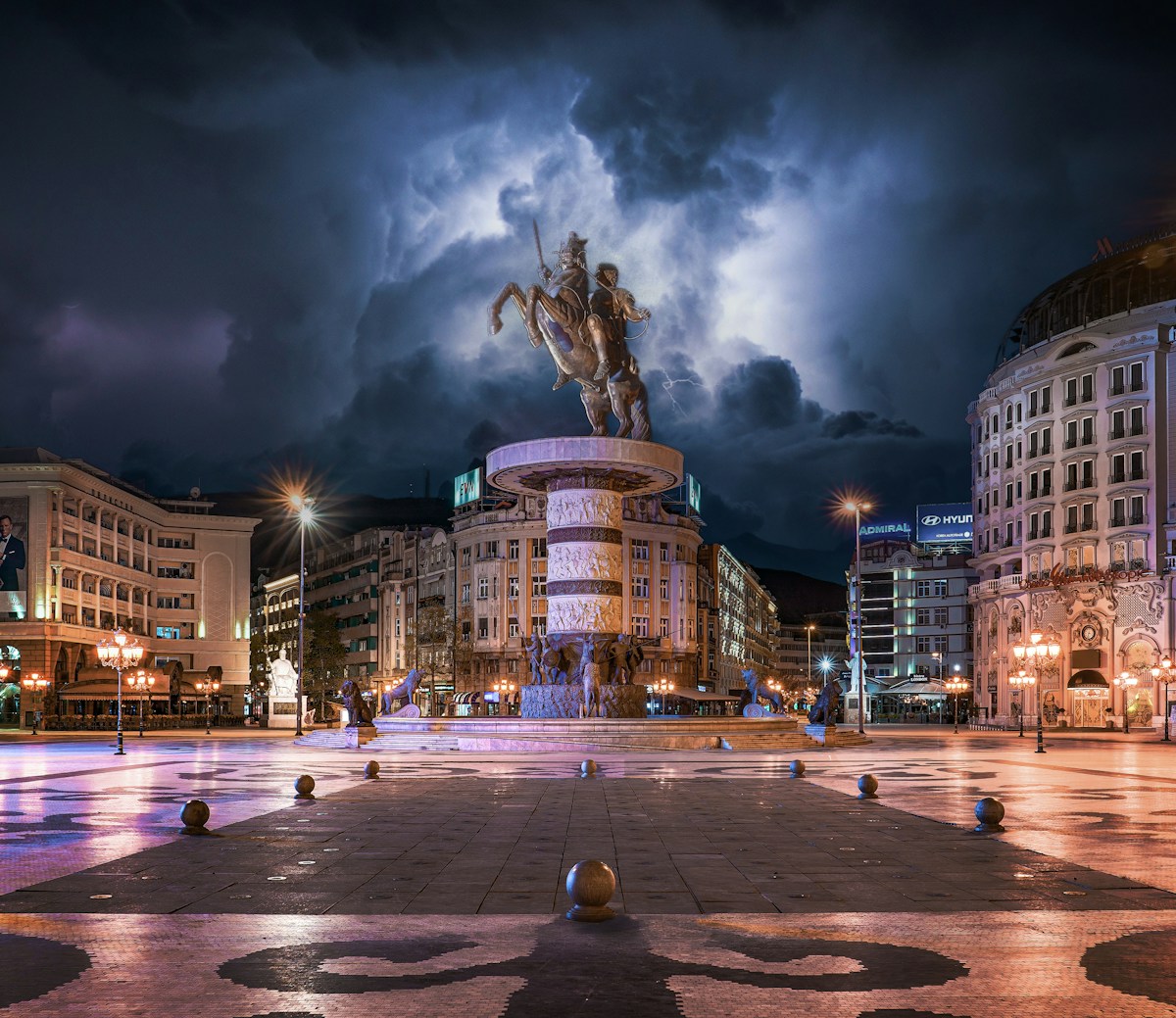
North Macedonia packs a remarkable amount into a small country: a capital city with one of the more surreal contemporary architecture projects in Europe, a lakeside UNESCO town with Byzantine churches above turquoise water, and a mountain national park within day-trip distance of both. Five days gives enough time for Skopje and Ohrid without rushing either. Get a Balkans eSIM before arrival — it covers North Macedonia and all neighbouring countries — and arrange travel insurance before departure.
All prices are in Macedonian Denar (MKD) with approximate euro equivalents (€). Estimates are as of 2026.
Overview
| Day | Area | Key activities |
|---|---|---|
| 1 | Skopje | Macedonia Square, old bazaar, Kale Fortress |
| 2 | Skopje | Matka Canyon day trip or city museums |
| 3 | Ohrid | St. John at Kaneo, Plaošnik, old town |
| 4 | Ohrid | Lake boat trip, Sveti Naum Monastery |
| 5 | Ohrid/depart | Bay of Bones, Ohrid to Skopje, departure |
Day 1 - Skopje: Macedonia Square and the old bazaar
Skopje’s Macedonia Square (Ploštad Makedonija) is the defining sight of the city and the most polarising. The “Skopje 2014” government urban project spent over €600 million filling the central square with neo-Baroque government buildings, fountains, and over 130 statues - including the enormous Warrior on a Horse monument (unofficially Alexander the Great) at the centre. Whether you see it as kitsch or impressive, it’s genuinely unlike anywhere else in Europe and worth an hour’s walk regardless of opinion.
The Stone Bridge (Kameni Most) connecting Macedonia Square to the old town dates from the 15th century. Cross it to reach the Old Bazaar (Čaršija) - one of the largest Ottoman-era bazaars in the Balkans, still functioning with jewellers, coppersmiths, textile merchants, and dozens of meyhane (traditional taverns). The Bit Pazar fresh market at the bazaar’s north end is active every morning. Browse Skopje tours and activities →
The Mustapha Pasha Mosque (1492) and the Daut Pasha Hammam (now the National Gallery of Macedonia) are the most significant Ottoman monuments in the bazaar. The hammam’s dual dome interior is one of the finest surviving examples in the region; entry approximately MKD 100 (€1.60).
Kale Fortress overlooks the entire city from a hill above the bazaar. The walls are largely intact and free to walk; the views over Skopje and the Vodno Mountain behind are the main reward. Allow 30–45 minutes.
Where to stay in Skopje:
- Mid-range: Hotel City Park - from approximately MKD 4,500–5,500/night (€72–89), central location
- Upper: DoubleTree by Hilton Skopje - from approximately MKD 7,000–9,500/night (€112–153), rooftop pool
- Search all Skopje hotels on Booking.com →
- Full guide: where to stay in Skopje
Dinner: Pivnica An in the old bazaar - grilled Macedonian tavče gravče (baked beans in clay pot, MKD 280–350/€4.50–5.60), kebapi (minced meat rolls, MKD 200–260/€3.20–4.20), and local Skopsko beer. Or Trend Restaurant near Macedonia Square for a broader Macedonian menu.
Day 2 - Skopje: Matka Canyon
Matka Canyon (15 km west of Skopje, bus or taxi approximately MKD 400–600/€6–10 one-way) is Skopje’s most rewarding day trip. The Treska River cuts a 5 km limestone gorge through the mountains; the canyon holds five lakes, 10 caves, a medieval fortress, and two monasteries. The most accessible cave is Vrelo Cave (boat tour from the Matka dam, approximately MKD 600/€10 per person) - stalactites and a subterranean lake with water of exceptional clarity. Browse North Macedonia tours and activities →
The hike along the canyon from the Matka dam to Sveta Nedela monastery (return, approximately 3 hours) passes two medieval churches and several viewpoints with no specialist gear required. Alternatively, rent a kayak or paddleboat at the lakeside (approximately MKD 500–800/€8–13/hour).
Šarengrob Monastery (Church of the Holy Virgin Matka), visible from the trail, has frescoes from the 14th and 16th centuries. The combined monastery and canyon visit makes a solid full-day excursion.
Alternative Day 2: The Holocaust Memorial Center for the Jews of Macedonia (free, Tue–Sun) is one of the most carefully curated museums in the Balkans, documenting the deportation and murder of the 7,000 Jews of Macedonia - 98% of the pre-war community - by Bulgarian occupiers in 1943. A sobering and important 2 hours. The Museum of Macedonia (MKD 100–150/€1.60–2.40) covers broader Macedonian history and archaeology if you prefer.
Day 3 - Ohrid: churches and old town
Bus from Skopje to Ohrid (2.5–3 hours, MKD 480–600/€7.70–9.70, multiple departures from Skopje’s main bus station). Ohrid is 170 km southwest of Skopje on the Albanian border.
Ohrid is on UNESCO’s dual World Heritage List for both its natural (Lake Ohrid) and cultural (old town and monuments) significance - an unusually rare status. The old town climbs the hillside above the lake with a density of Byzantine and medieval churches. Ohrid was the centre of the First Bulgarian Empire’s ecclesiastical life in the 10th century, when Saints Clement and Naum established the Ohrid Literary School - credited as the birthplace of the Cyrillic alphabet.
St. John at Kaneo (Sveti Jovan Kaneo, entry approximately MKD 100/€1.60) is the most photographed church in North Macedonia: a small 13th-century Byzantine chapel on a headland above the lake, with views across the water to the Albanian mountains. Best visited at golden hour. Browse Ohrid tours and activities →
Plaošnik (St. Clement’s Basilica, entry approximately MKD 100/€1.60) is the most historically significant site in Ohrid - a 9th-century basilica built on the site of a 5th-century Early Christian church, with a partially excavated mosaic floor and the tomb of St. Clement. Immediately above is the Tsar Samuel’s Fortress (MKD 60–80/€1), the medieval walls that circle the old town hill.
Church of Sveta Sofija (entry approximately MKD 100/€1.60) is the city’s main cathedral - an 11th-century Byzantine church with substantial surviving frescoes from the 11th–14th centuries, including a remarkable Christ Pantocrator in the apse.
Where to stay in Ohrid:
- Budget: Sunny Lake Hostel - from approximately MKD 800–1,000/dorm (€13–16), lake views
- Upper: Hotel Riviera - from approximately MKD 5,500–7,500/night (€89–121), lakefront terrace
- Search all Ohrid hotels on Booking.com →
- Full guide: where to stay in Ohrid
Dinner: Restaurant Antiko in the old town (Korolebska 10) - Macedonian lake trout (pastrmka, MKD 600–800/€9.70–12.90), stuffed peppers (polni piperki, MKD 350–450/€5.60–7.30), and local Tikveš wine. Or Restaurant Letna Bavča Kaneo on the lake terrace for fish and views.
Day 4 - Lake Ohrid: boat trip and Sveti Naum
Lake Ohrid is one of Europe’s oldest and deepest lakes - at least 1.2 million years old and up to 289 metres deep. The water clarity is exceptional (visibility up to 22 metres) and the lake is home to endemic species found nowhere else, including the Ohrid trout (pastrmka).
Hire a boat or take a scheduled service from Ohrid to Sveti Naum Monastery (30 km south along the Albanian border, boat approximately MKD 1,000–1,200/€16–19 return, or bus approximately MKD 120/€2). The monastery sits on a rocky promontory above a spring - one of the lake’s main freshwater sources - and houses the tomb of St. Naum, who founded it in 905. The peacocks roaming the grounds are a local fixture.
The spring pools (Izvori na Crni Drim) behind the monastery are remarkable: crystal-clear, intensely blue, and the starting point of the Black Drim River that drains into Albania. A rowing boat tour of the springs costs approximately MKD 300 (€4.80) per person.
Return to Ohrid by boat or bus for the evening. The Ohrid Old Bazaar runs along Sveti Kliment Ohridski street - antique shops, Macedonian linen, hand-painted icons, and cafés make for pleasant browsing.
Day 5 - Bay of Bones and departure
The Bay of Bones Museum (Muzej na voda, entry approximately MKD 100/€1.60) at the Hotel Gradište campsite (7 km from Ohrid, taxi approximately MKD 400/€6) is a reconstructed prehistoric lake dwelling built on piles above the water - a reconstruction based on a 3,500-year-old Bronze Age settlement excavated in the 1990s. Small but genuinely unusual.
Return to Ohrid to catch the early afternoon bus back to Skopje (2.5–3 hours) for evening flights. Direct buses also connect Ohrid to Tirana, Albania (3.5–4 hours, approximately €10–12) for travellers continuing the Balkans circuit southward. Search Skopje hotels for departure night →
Onward connections from Skopje: Buses to Belgrade (5–6 hours, €15–20), Sofia (3–3.5 hours, €10–12), Pristina (2 hours, €6–8), Tirana (3.5 hours, €12–15), and Athens (8 hours, €20–25) all depart from Skopje’s main bus terminal. Flights from Skopje Alexander the Great Airport serve London Luton, Vienna, Amsterdam, Zurich, and other Western European cities.
Where to Stay
- Skopje — Where to stay in Skopje
- Ohrid — Where to stay in Ohrid
Things to do at each stop:
See also
- North Macedonia travel guide
- Skopje
- Ohrid
- Ohrid vs Budva
- Balkans travel costs
- Kosovo travel guide
- Albania travel guide
- Hiking in the Balkans
- National parks in the Balkans
- Planning a Balkans trip
Book Your Trip
Flights — search and compare on Aviasales eSIM — stay connected with Airalo Travel insurance — get covered with EKTA Airport transfers — book with Kiwitaxi Car rental — compare with GetRentaCar Hotels — compare and book accommodation on Booking.com Tours and activities — browse GetYourGuide