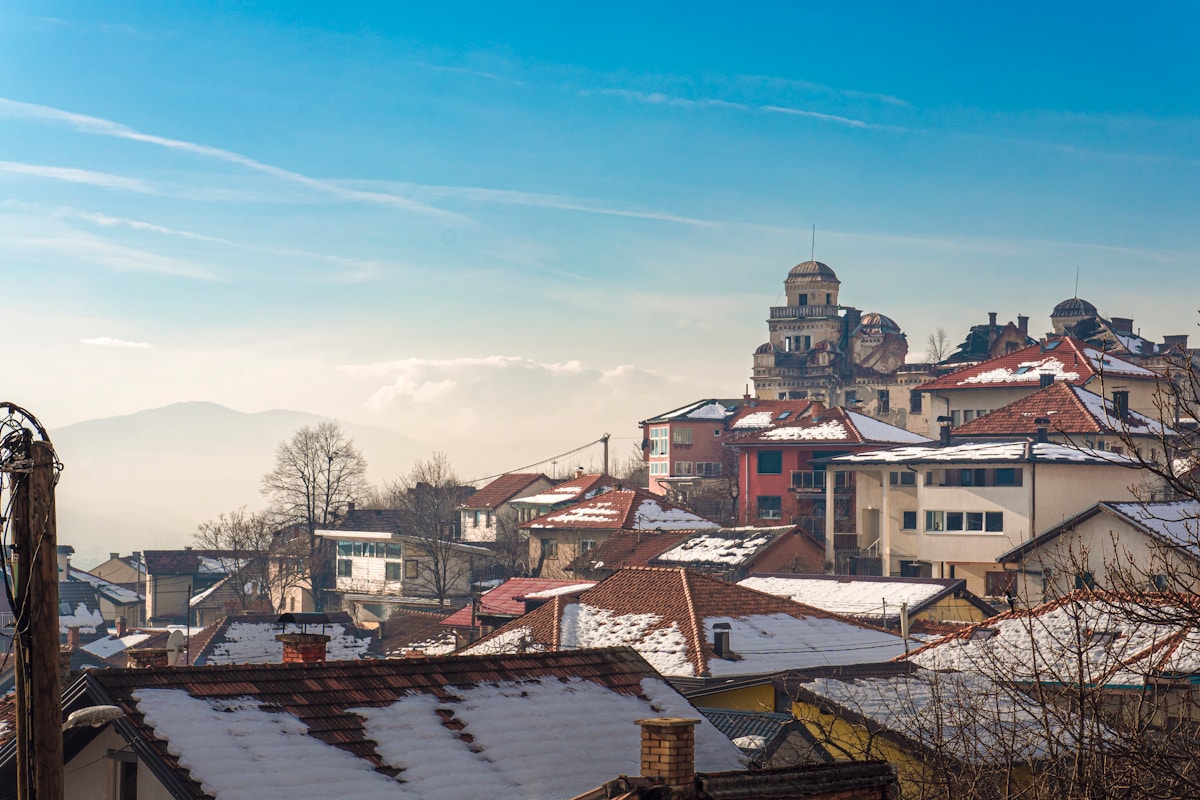
December transforms the Balkans from a beach-and-hiking destination into something entirely different: a string of European cities with Christmas markets, mountain ski resorts opening for the season, and hotel prices that make Western European winter travel look extortionate by comparison. This is the month when Sarajevo gets snow, Belgrade rings in New Year’s Eve louder than anywhere in the region, and Bansko opens its lifts.
The coast quiets. The cities and mountains take over.
Christmas Markets Across the Balkans
Sarajevo — Baščaršija Winter Festival
Sarajevo’s Christmas market occupies the Baščaršija bazaar from approximately 1 December through 6 January (Orthodox Christmas). Unlike the largely commercial Western European markets, Sarajevo’s version is embedded in a working 15th-century Ottoman bazaar still occupied by silversmiths, coffee roasters, and leather goods makers. Stalls sell Bosnian coffee, rakija, roštilj (grilled meats), and lokum. Entry is free, the atmosphere is genuine, and the cityscape — a mix of Ottoman minarets and Austro-Hungarian facades lit in winter light — is unlike anything else in Europe.
The market is walkable from anywhere in the old town. Mulled wine from approximately BAM 3 (EUR 1.50). A ćevapi plate with flatbread from approximately BAM 7 (EUR 3.50).
Sofia — Winter Festival
Sofia’s Christmas market runs along Vitosha Boulevard and around the NDK (National Palace of Culture) plaza through the second week of January. It is one of the most underrated in Eastern Europe — large, well-lit, and backed by the snow-capped Vitosha mountain in the distance on clear days. Bulgarian mulled wine (glintwein) from approximately BGN 4 (EUR 2). Banitsa (filo pastry with cheese or pumpkin) from stalls around the market from BGN 2 (EUR 1).
The Sofia market is 2 hours from Bansko by car, making a city/ski combo very practical for December travel.
Ljubljana — Festive Fair
Ljubljana’s Christmas market is compact and beautiful. It runs along the Ljubljanica River and around the Triple Bridge from late November through early January. The Old Town is small enough to walk in an afternoon, and the market covers it well — ice rinks, craft stalls, and a Christmas tree in Congress Square. A mulled wine costs approximately EUR 3–4. Entry to everything is free. Ljubljana is Slovenia’s capital and, as such, has the most developed transport connections into the rest of the region.
Belgrade — Winter in the City
Belgrade does not have a traditional Christmas market on the Zagreb or Sofia scale, but the city centre — Knez Mihailova Street, Republic Square, and the Skadarlija bohemian quarter — does put on winter lights and outdoor stalls from early December. The main event in Belgrade in December is New Year’s Eve: outdoor concerts, light shows on the river, and parties that run until dawn. Hotels book up for New Year’s weekend. Book 6–8 weeks in advance for that specific stretch.
Skopje — Macedonia Square
Skopje’s Christmas market centres on Macedonia Square and the Stone Bridge, with the Vardar River providing a backdrop. The city has invested heavily in its central zone and the winter lighting is impressive. Less visited than Zagreb or Ljubljana, Skopje offers some of the most affordable prices in the Balkans — mulled wine from approximately MKD 80 (EUR 1.30), restaurant meals from EUR 8–12.
Zagreb — Advent Zagreb
Zagreb Advent is the benchmark Balkans Christmas market — consistently rated among Europe’s top five by the European Best Destinations organisation. It spans six zones across the city centre (Zrinjevac Park, Ban Jelacic Square, the Cathedral Steps, King Tomislav Square, Nikola Subic Zrinski Square, and Strossmayer Square) from late November through 7 January. Ice rinks, a Ferris wheel, and hundreds of craft and food stalls. Mulled wine approximately EUR 2.50. Entry to all zones is free. The Zagreb Funicular runs from Lower to Upper Town (HRK 1 / EUR 0.13 per trip) — take it for the elevated view of the market lights.
Skiing in December
Balkan ski resorts offer some of the best price-to-quality ratios in European skiing. Here is what opens in December and when:
| Resort | Country | Typical opening | Day pass approx. |
|---|---|---|---|
| Bansko | Bulgaria | ~15 December | EUR 35–38 |
| Kopaonik | Serbia | ~10–15 December | EUR 30–35 |
| Jahorina | Bosnia | ~15 December | EUR 22–28 |
| Bjelasnica | Bosnia | ~20 December | EUR 15–20 |
| Kolasin 1450 | Montenegro | ~20 December | EUR 25–30 |
Bansko (75 km of runs, top altitude 2,560m) is the most reliable and most developed, with a full village of accommodation, restaurants, and après-ski bars. A 6-day ski pass costs approximately EUR 185–200 in early December.
Kopaonik (Serbia’s largest resort, 55 km of runs) combines good skiing with accessible prices. The base town, also called Kopaonik, has hotel accommodation from approximately EUR 50 per night for a mid-range double in December.
Jahorina (near Sarajevo, 20 km of runs) is the most atmospheric — the 1984 Winter Olympics were held here, and the resort has a low-key, un-commercialised feel. Lift passes are among the cheapest in Europe.
Where to Stay in December
Sarajevo: Hotel Europe Sarajevo — a grand Austro-Hungarian property near the Baščaršija from approximately EUR 70–100 per night in December. For proximity to the market, Hotel Michele from EUR 60–80.
Sofia: Grand Hotel Sofia on Gurko Street from approximately EUR 80–110 per night in December. The location is a 5-minute walk to Vitosha Boulevard and the market.
Ljubljana: Hotel Vander Urbani Resort in the Old Town from approximately EUR 120–160. Budget option: Hostel Tresor Ljubljana from EUR 18 per dorm bed.
Belgrade: Hotel Square Nine on Studentski Trg from approximately EUR 110–150. New Year’s week prices spike — add 30–40%.
Skopje: DoubleTree by Hilton Skopje from approximately EUR 60–80 per night in December.
Suggested December Routes
5 nights: Christmas Market circuit
Fly into Ljubljana (1 night, Festive Fair) → bus to Zagreb (2 nights, Advent Zagreb) → fly or bus to Sarajevo (2 nights, Baščaršija Winter Festival). End: fly home from Sarajevo.
7 nights: Cities + Skiing
Fly into Sofia (2 nights, winter market) → Bansko ski resort (3 nights, ski) → overnight bus to Sarajevo (2 nights, Baščaršija market). End: fly home from Sarajevo.
New Year’s Eve only
Fly into Belgrade for New Year’s weekend — the city has outdoor concerts, bars open until dawn, and affordable hotels outside the NYE peak. Book 6–8 weeks ahead.
December Budget Overview
| Category | Cost range |
|---|---|
| Hostel dorm (Belgrade, Skopje, Sarajevo) | EUR 13–20 per night |
| Mid-range hotel (Sarajevo, Sofia, Skopje) | EUR 55–90 per night |
| Mid-range hotel (Ljubljana, Zagreb) | EUR 100–160 per night |
| Ski day pass (Bosnia/Serbia) | EUR 22–35 |
| Ski day pass (Bansko) | EUR 35–38 |
| Restaurant meal, mid-range | EUR 12–20 (Bosnia/Serbia/North Macedonia) |
| Mulled wine at Christmas market | EUR 1.50–4 |
Flights from London to Belgrade in December: from approximately GBP 65 return. Sofia: from GBP 60. Ljubljana: from GBP 80.
December in the Balkans is a case study in what European Christmas travel looks like before it gets packaged, inflated, and over-photographed. Sarajevo’s market is more authentic than Vienna’s. Bansko’s ski passes cost less than a third of Val d’Isère’s. Belgrade’s New Year is as energetic as Prague’s at a fraction of the price. The argument makes itself.