Best Food in Croatia: What to Eat and Where
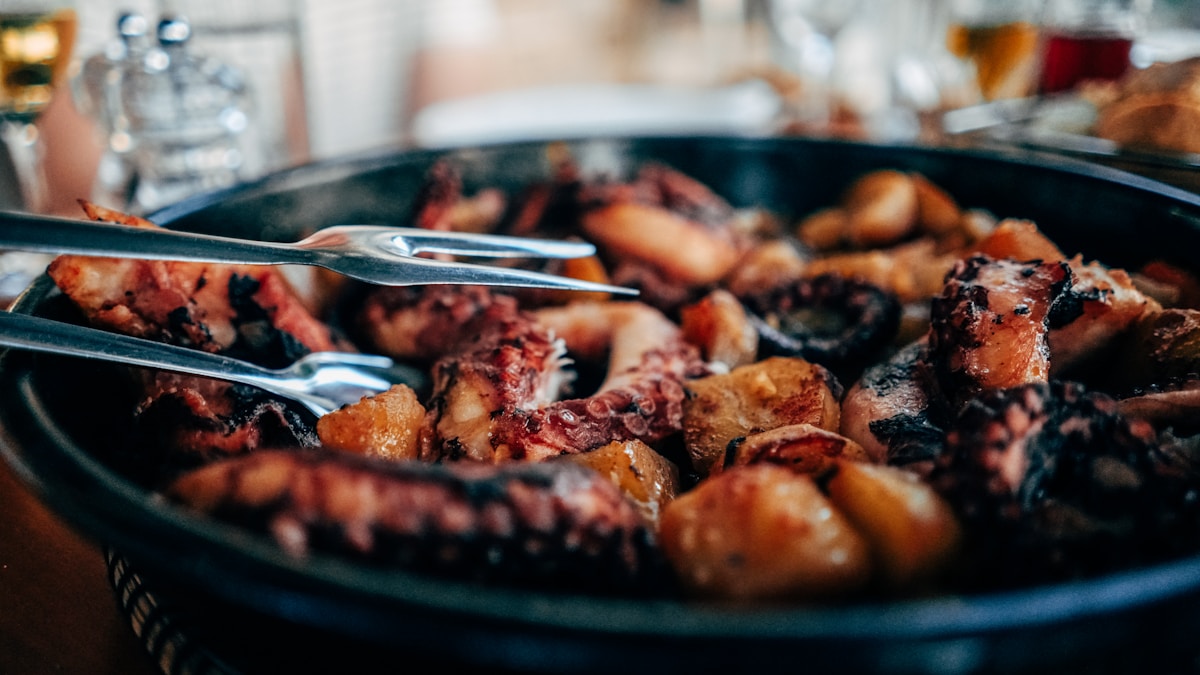
Croatian food is one of the most varied in the Balkans, shaped by two very different traditions: the Adriatic coast, where Dalmatian and Istrian cooking pulls from Italian and Mediterranean influences, and the inland regions around Zagreb, where Central European flavours dominate. The result is a cuisine you can eat for two weeks without repetition. Prices below are approximate as of 2026; Croatia uses the euro (EUR).
The Essential Dishes
Peka
Peka is arguably Croatia’s most celebrated dish — lamb, veal, or octopus slow-cooked under a bell-shaped iron lid (peka in Croatian) buried in hot embers. The technique concentrates the flavours and produces meat or seafood so tender it pulls apart with a spoon. It requires advance notice at most restaurants (typically 24 hours), but the wait is worth it.
The octopus peka — whole octopus cooked with potatoes, garlic, rosemary, and olive oil — is the signature version along the Dalmatian coast. Order it at any konoba with a wood-fire kitchen.
Price: EUR 18–30 per person, depending on the protein.
Pašticada
Pašticada is the formal dish of Dalmatia — beef (usually silverside) marinated for 24 hours in wine, vinegar, and spices, then slow-braised with prunes and served over homemade gnocchi. It is elaborate enough that Dalmatian households cook it only for weddings and celebrations, but a good konoba will make it available year-round.
The sauce, reduced from the braising liquid, is dark and sweet-sour in a way that has no equivalent elsewhere in the Balkans.
Price: EUR 16–26 for a main course portion.
Black Risotto (Crni Rižot)
Crni rižot is risotto cooked with cuttlefish and its ink, giving it a deep black colour and a briny, umami-rich flavour. It is the definitive Adriatic rice dish and appears on menus from Dubrovnik to Rovinj. Good crni rižot is creamy and well-seasoned — it should coat the back of a spoon.
Price: EUR 12–22.
Cevapi (Croatian Style)
Croatia has its own version of ćevapi — the grilled minced meat sausages found across the former Yugoslavia. The Croatian version leans slightly leaner and is often served with flatbread and raw onion rather than the lepinja (softer bread) used in Bosnia. Not the definitive version of the dish — Bosnia holds that distinction — but it appears on almost every konoba menu as an accessible crowd-pleaser.
Price: EUR 10–16 for a portion.
Štrukli
Štrukli are Zagreb’s signature dish — dough pockets filled with fresh cottage cheese, either boiled or baked. They are simultaneously a starter, a main course, and a snack, and the question of boiled versus baked divides Zagreb locals the way arguments about coffee divide everywhere else. The baked version gets a golden crust; the boiled version is softer and richer.
Price: EUR 6–12 in Zagreb restaurants; cheaper at traditional gostionica (casual taverns).
Istrian Truffle Dishes
The Istrian peninsula around Motovun and Buzet produces black and white truffles of exceptional quality, and the region makes the most of them. Truffle pasta (fuži — a hand-rolled pasta shape) finished with fresh shavings is the classic format, but you will also find truffle risotto, truffle scrambled eggs, and truffle cheese on degustacijska (tasting) menus.
Price: EUR 18–40 for truffle pasta, depending on whether white or black truffles are used. White truffle dishes are significantly more expensive in autumn.
Burek
Burek across Croatia is typically filled with meat or cheese and sold from pekara (bakery) shops. It is the dominant street-food-and-breakfast pastry along the coast and inland. The Croatian version is similar to the Bosnian standard, though thinner and crispier in some regions.
Price: EUR 1.50–3.50 per slice.
Fresh Adriatic Seafood
Beyond peka, the Adriatic coast excels at simplicity — grilled fish dressed with olive oil, garlic, and lemon is ubiquitous and reliably good. Dentex (zubatac), sea bass (brancin), and bream (orada) are the local favourites. Mussels (dagnje na buzaru) — cooked in a garlicky white wine sauce — appear as a starter on almost every coastal menu.
Price: Whole grilled fish is sold by weight — expect EUR 20–45 per kg depending on species. Mussel buzara: EUR 8–14.
Where to Eat in Dubrovnik
Konoba Colentum (Masarykov Put 3, Lapad) — One of the better-value options within reach of Dubrovnik’s tourist centre, away from the old city premium. Serves Dalmatian standards: grilled fish, black risotto, peka (order ahead). Mains approximately EUR 18–28. Popular with visitors and locals alike.
Nishta (Prijeko 30, Old Town) — Dubrovnik’s best-known vegetarian and vegan restaurant, with a menu of creative Mediterranean dishes. No meat or fish. Mains EUR 14–20. Reliably good when the old city’s meat-heavy menus feel repetitive.
Konoba Lokanda Peskarija (Na Ponti, Old Town) — Excellent mussels and seafood stew at a low premium for old-city location. The mussel buzara is the main event. Mains EUR 12–22. Best at lunch when it is slightly quieter.
Where to Eat in Split
Konoba Matoni (Ul. Grgura Ninskog 3) — Unpretentious neighbourhood konoba a short walk from Diocletian’s Palace. Pašticada, peka, and grilled fish. Mains EUR 14–24. Reliable and honest cooking away from the tourist-facing strip.
Fife (Trumbićeva Obala 11) — Long-running, no-frills seafront restaurant beloved by Split locals for its cheap, generous portions. The fish and the peka are exceptional value. Mains EUR 10–18. Expect a queue at lunch.
Apetit (Subićeva 5) — Slightly more polished than most Split konobas, with a good wine list of Dalmatian varieties. The crni rižot and pašticada are well-executed. Mains EUR 18–28.
Where to Eat in Zagreb
Vinodol (Nikole Tesle 10) — Zagreb institution open since 1975, known for traditional Croatian cooking in a stone-walled restaurant with a covered terrace. The štrukli, roast lamb, and duck with mlinci (thin pasta baked dry in meat juices) are the mainstays. Mains EUR 14–26.
Lari & Penati (Petrinjska 42a) — Small, lively restaurant specialising in pasta and traditional Zagreb dishes with a contemporary edit. The štrukli are excellent. Mains EUR 12–20.
Mundoaka Street Food (Petrinjska 2) — Zagreb’s best-known street food spot, serving globally-influenced sandwiches and plates at low prices. Not traditionally Croatian, but excellent for a fast, well-made lunch. Mains EUR 8–14.
Drinking Alongside the Food
Croatian wine is the best-kept secret in the Balkans. The Plavac Mali grape — grown along the Dalmatian coast and on Hvar and Korčula islands — produces deep, structured red wines that rival Italian varietals at half the price. Bottles start at EUR 12–20 in restaurants. On Istria, local Malvazija (a dry white) is the house wine in almost every konoba.
Rakija — the regional fruit brandy — is served before meals as a digestive aperitif. Travarica (herb rakija) and šljivovica (plum) are the Croatian standards. EUR 3–6 per measure in restaurants.
Craft beer has grown significantly in Croatian cities since 2018. Zagreb, Split, and Dubrovnik all have craft beer bars with local and regional labels.
Practical Notes
- Reserve peka in advance: Most restaurants require 24–48 hours’ notice for peka dishes — ask when booking.
- Pekara (bakeries) are open from 06:00 and are the cheapest breakfast option anywhere on the coast.
- Fish prices: Check whether menu fish prices are per portion or per 100g — the difference matters when ordering a whole grilled fish.
- Tipping: 10% is standard at sit-down restaurants; rounding up is sufficient at casual spots.
See Also
Plan your trip: Browse food tours and cooking experiences in Croatia or Dubrovnik food tours specifically. Search flights to Croatia and compare prices early.
Book an experience
Food tours & cooking classes
A guided food tour covers more ground than eating solo — and you learn the backstory.