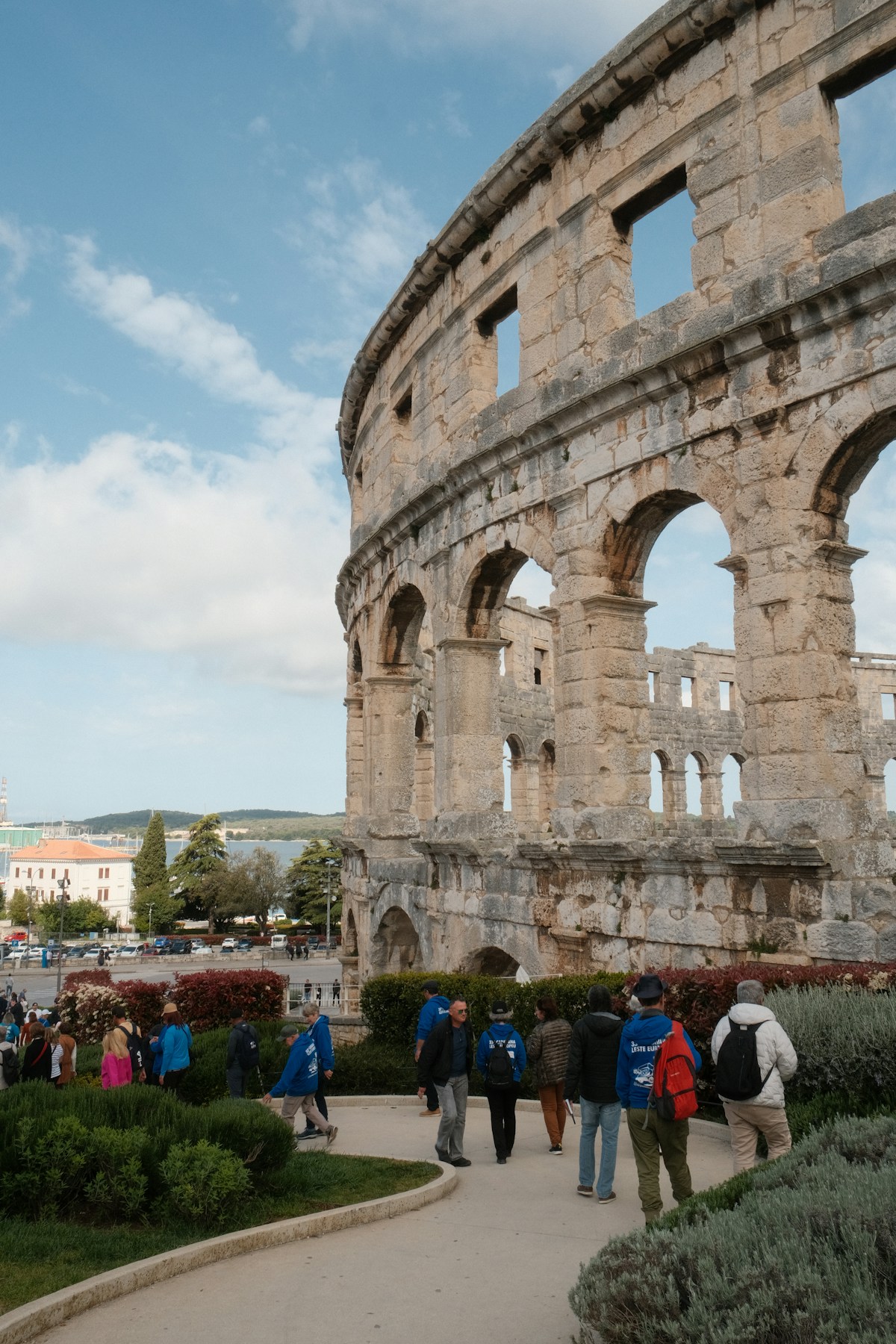
Pula has the most substantial concentration of Roman architecture in Croatia outside of the Split palace complex. The Arena is the anchor, but it sits within a walkable old town where Roman gates, temples, and forum stones are woven into the urban fabric alongside cafés, bars, and local shops. All prices in euros (€).
Pula Arena
The 1st-century amphitheatre that defines the city. Built under Augustus and Vespasian, it is one of the six largest Roman amphitheatres in the world and structurally intact on all four sides - unusually complete. The seating tiers, exterior arcades, and underground corridors are all accessible.
- Entry: approximately €12–18 as of 2026; open daily year-round
- Opening hours: typically 8:00–21:00 in summer, shorter in winter - check current times at the ticket desk
- Best time to visit: before 10:00 or after 16:00 in July–August to avoid peak crowds
- Guided tours: approximately €20–35 for a 1-hour guided walk; book at the ticket desk or via GetYourGuide Pula Film Festival: held annually in July–August inside the Arena since 1954. Film screenings projected onto the ancient stone at night - tickets from approximately €10–20. One of the more memorable ways to spend an evening in Pula.
Roman Forum and Temple of Augustus
The main city square has been the civic centre of Pula continuously since the 1st century BCE. The Temple of Augustus on the northern edge is one of the best-preserved Roman temples outside Italy - its Corinthian colonnade is nearly intact, saved because the building served as a church and then a granary through the medieval period.
- Temple of Augustus entry: approximately €5; includes a small archaeological collection
- Forum: free, accessible at any hour
- Restaurant Kantina sits directly on the Forum square with the temple facade as backdrop - mains approximately €18–30, good for a longer lunch
Other Roman Monuments (all free)
The old town is compact enough to cover all of these on foot in an afternoon:
- Arch of the Sergii - a 1st-century BCE triumphal arch on the edge of the old town, built to commemorate a local Roman family after the Battle of Actium
- Twin Gates (Porta Gemina) - a 2nd-century CE Roman city gate, well-preserved
- Hercules Gate - the oldest Roman monument in Pula, 1st century BCE, in the old town
- Cathedral of the Assumption - built on a Roman temple foundation and a Byzantine church; free entry
- Zero Strasse (Nula Strasse) - a network of underground wartime tunnels from the Austro-Hungarian and Italian periods; entry approximately €5, guided tours run in summer
Archaeological Museum of Istria - on the hill above the Forum, the most comprehensive collection of Roman finds from the region: mosaics, glassware, inscriptions. Entry approximately €5. Closed Mondays.
Cape Kamenjak
A 35km² nature park on the peninsula 13km south of Pula, with some of the clearest water and best snorkelling on the northern Adriatic coast. Rocky coves, no development, and a dramatically different atmosphere from the city.
- Park entry by car: approximately €8–10 as of 2026 (waived in low season)
- July–August restriction: no private vehicles beyond the main car park - shuttle bikes and scooters available to rent at the entrance
- Best coves: Safari Bar area and Stupice, a short cycle from the gate
- By bicycle from Pula: bike rental approximately €15–20/day; the flat route via Medulin takes about 45–60 minutes. Organised e-bike tours from Pula to Kamenjak run approximately €40–60
Brijuni Islands
The Brijuni archipelago - 14 islands 6km west of Pula - was the summer residence of Yugoslav leader Tito and is now a national park. Veliki Brijun, the main island, has a safari park (with animals gifted to Tito by African heads of state), Roman villa ruins, and a collection of Tito-era memorabilia.
- How to get there: ferry from Fažana, 8km north of Pula (bus from Pula market, about 20 minutes)
- Entry, ferry, and guided tour combined: approximately €30–45 as of 2026
- Important: independent access is restricted - you must join a park tour; you cannot arrive by ferry and explore alone
- Season: most tour options run April–October; limited winter options
Guided Tours and Organised Activities
- Arena guided walking tours: €20–35 per person, approximately 1 hour
- E-bike tours to Cape Kamenjak: €40–60, including the park entry fee
- Brijuni boat day trips: €30–45 including ferry and guide
- Wine and food tours of Istria: half-day excursions from Pula into the Istrian interior (Motovun, Grožnjan, Poreč) typically run €60–90 per person including tastings
- Kayaking: sea kayak tours along the Pula coastline approximately €40–60 per person
Browse the full range at GetYourGuide Pula.
Day Trips from Pula
- Rovinj: 45 minutes by bus (€5–8), one of the most photogenic old towns on the Adriatic
- Motovun: 1 hour by car; a hilltop medieval town in the Istrian interior, in the heart of truffle country
- Poreč: 45 minutes by bus; the Euphrasian Basilica (UNESCO) is the draw
- Istria road trip: a full day by hire car covers the hilltop towns (Motovun, Grožnjan, Oprtalj) and a winery stop
Price Summary
| Activity | Price |
|---|---|
| Pula Arena entry | €12–18 |
| Temple of Augustus | €5 |
| Zero Strasse underground tunnels | €5 |
| Archaeological Museum of Istria | €5 |
| Cape Kamenjak park (car) | €8–10 |
| Brijuni Islands (entry + ferry + tour) | €30–45 |
| Guided arena tour | €20–35 |
| E-bike tour to Kamenjak | €40–60 |
Book activities: GetYourGuide Pula lists guided arena tours, Brijuni boat trips, and Kamenjak e-bike excursions. Hire a car for the Istrian hill towns and the Kamenjak peninsula independently.