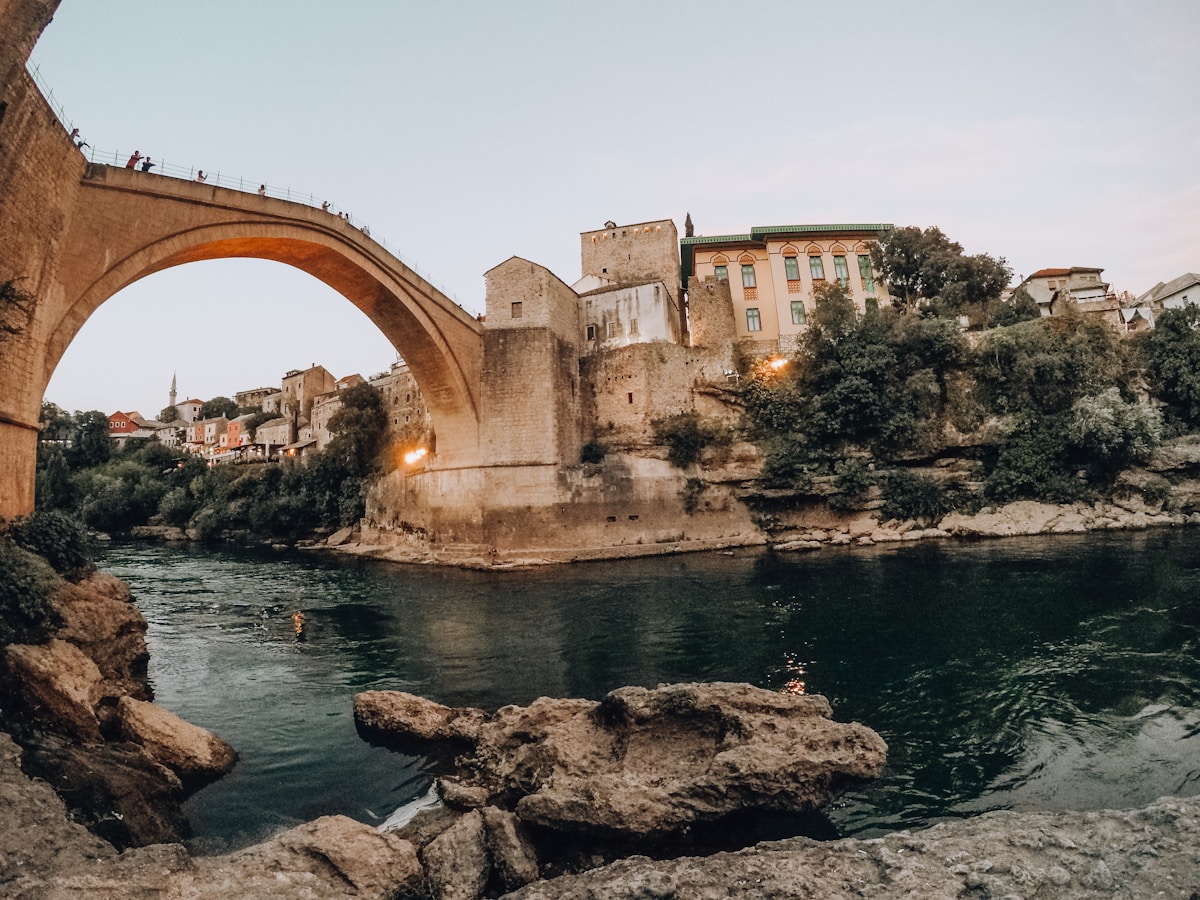
Stari Most - rebuilt in 2004 after its 1993 destruction, the 16th-century Ottoman arch crossing the Neretva River - is the defining image of Mostar. But the bridge is not only a monument. Local divers have been jumping from it for centuries, and the tradition has never stopped.
How High Is Mostar Bridge?
Stari Most stands 21 metres above the surface of the Neretva River - roughly the height of a seven-storey building, or more than twice the height of an Olympic 10-metre diving platform. The jump is measured from the bridge parapet to the river surface; the impact at that height is significant enough that a poor water entry risks serious injury.
For comparison: Olympic cliff divers compete from 27 metres. At 21 metres, Stari Most is in the same category - the kind of height where form matters as much as courage. The Mostari divers’ club trains for months before a member attempts the full jump, maintaining strict standards about entry technique. A controlled feet-first entry, arms tight, chin tucked, is what separates a clean dive from a dangerous one.
The bridge deck itself is approximately 4 metres wide with stone parapets on either side. The practical jump point is from the highest section of the parapet, which gives the 21-metre measurement. Water temperature in summer sits at approximately 16–18°C; the cold shock on impact adds a further variable.
The Tradition
Bridge jumping in Mostar predates the current bridge. The original Stari Most was completed in 1566, and local accounts record jumping as a test of courage among young men of the town within decades of construction. The practice formalised over time into a competitive tradition, with annual competitions dating back at least to the 1960s under Yugoslav-era sports organisations.
After the bridge was destroyed by Croatian nationalist forces in November 1993, jumping paused. When the reconstructed bridge reopened in 2004, the divers returned. The club now functions as both a sporting body and an informal heritage organisation, passing the tradition between generations.
The Mostari Divers’ Club
The club operates from a small tower on the eastern side of the bridge. Their revenue comes primarily from donations - spectators who stop to watch, and tourists who want to attempt the jump themselves. The financial model is important to understand: the divers perform because people pay attention, and if visitors leave without contributing, the tradition becomes economically unsustainable.
The standard spectator donation is approximately 5–10 BAM (around €2.50–5) passed to a club member before the jump. Watchers who photograph or film without donating are noticed, and politely prompted. This is not aggressive - it is simply how the club operates.
For those wanting to participate, the cost is approximately 50 BAM (around €25). This includes instruction from a club member, a supervised warm-up from a lower platform (around 10 metres), and then the option to attempt the full 21-metre jump if the instructor is satisfied with your technique. The entry form matters: feet-first, arms tight, chin tucked. A sloppy entry from height can result in injury.
Watching vs Jumping
Watching the jump is the default for most visitors, and it is genuinely spectacular. The best viewing positions are on the bridge itself (though this blocks the jumpers’ approach and the divers will ask you to move), and from the Tabbachi kafana terrace on the west bank, which gives an unobstructed side-on view of the arc.
Attempting the jump requires more commitment than most travellers anticipate. You are not simply queuing up to take a turn. The club screens participants for basic fitness, explains the training jump, and makes the decision about whether you are ready for the full height. It is not a tourist activity in the casual sense - it is a supervised sport with real physical stakes.
If you want to jump: arrive in the morning before the crowds build, speak to a club member at the tower, and budget a full morning for the experience including the preparation time.
The Red Bull Cliff Diving Connection
Red Bull’s Cliff Diving World Series - the highest-profile extreme diving competition globally - has included Stari Most as a venue. When the event returns to Mostar (it has run multiple times, most recently in 2023), the competition attracts international professional divers performing from higher platforms rigged above the bridge, performing complex acrobatic entries. This is a different event from the everyday tradition, but it has raised the bridge’s international profile considerably.
Local competition: the traditional Mostar diving competition (Mosto skakanje) runs annually in late July or early August. Entry is open to trained local divers only; spectators line the banks and bridge approaches. Dates vary year to year - check with Mostar’s tourist information office closer to your visit.
Safety Notes
The Neretva is fast-moving. Underwater, the current pushes downstream even when the surface appears calm. The divers always exit to the right bank (east side) after surfacing - follow this instruction if you jump. Do not swim upstream against the current.
Water temperature: approximately 16–18°C in July and August, colder in spring and autumn. The cold shock on impact is significant. Hyperventilation in cold water is a real risk. Breathe steadily before jumping, and exhale as you surface.
The club does not permit solo jumping without their supervision. The occasional tourist who attempts to jump independently - usually at night, after drinking - has ended in injury on the rocks. The underwater topography below the bridge includes submerged stone; the divers know exactly where the safe entry zone is. Without that knowledge, the risk increases substantially.
Best Time to Visit
Late morning to mid-afternoon (roughly 10am–4pm) in July and August gives you the best chance of seeing multiple jumps. The divers jump when there is enough of a crowd to make it worthwhile, which requires peak hours.
For a cooler and less crowded experience, May, June, and September hit a balance between reliable warm weather and manageable tourist numbers. The bridge is extraordinary in any season, but the jumping tradition slows considerably outside the main summer months.
Mostar Tours at a Glance
| Tour | Duration | From (approx) | Best For |
|---|---|---|---|
| Mostar Old Town Walking Tour | 2 hrs | €18 | History context, Stari Most story |
| Mostar City and Museum Tour | 2 hrs | €20 | Siege history, war museum |
| Neretva River Rafting from Mostar | Full day | €45 | Active travellers, canyon scenery |
Browse all Mostar tours on GetYourGuide
Getting to Mostar
From Dubrovnik: The most common approach. Drive via Neum (Bosnia’s coastal corridor - you will cross two Croatian border checkpoints); total journey approximately 2 hours 30 minutes to 2 hours 45 minutes by car. Organised day tours from Dubrovnik are available from approximately €45–65 per person, including transport and a local guide; the most popular option also adds a stop at Kravica Waterfalls - book the Mostar and Kravica day trip if you want both in one day.
From Sarajevo: Two and a half hours by car along the M17 - a spectacular drive following the Neretva valley through canyon scenery. Buses run regularly from Sarajevo’s central bus station; journey approximately 2 hours 30 minutes, fare approximately 20 BAM (€10) one way.
Parking in Mostar: Aim for the car parks on the east bank near the Old Bazaar. Approximately 2–3 BAM per hour. The Old Town itself is largely pedestrianised.
Book a guided day trip from Dubrovnik or Sarajevo that includes Stari Most, the Old Bazaar, and a local guide: Tours in Mostar | Day trips from Dubrovnik into Bosnia
See also: Bosnia & Herzegovina travel guide | What to see in Mostar