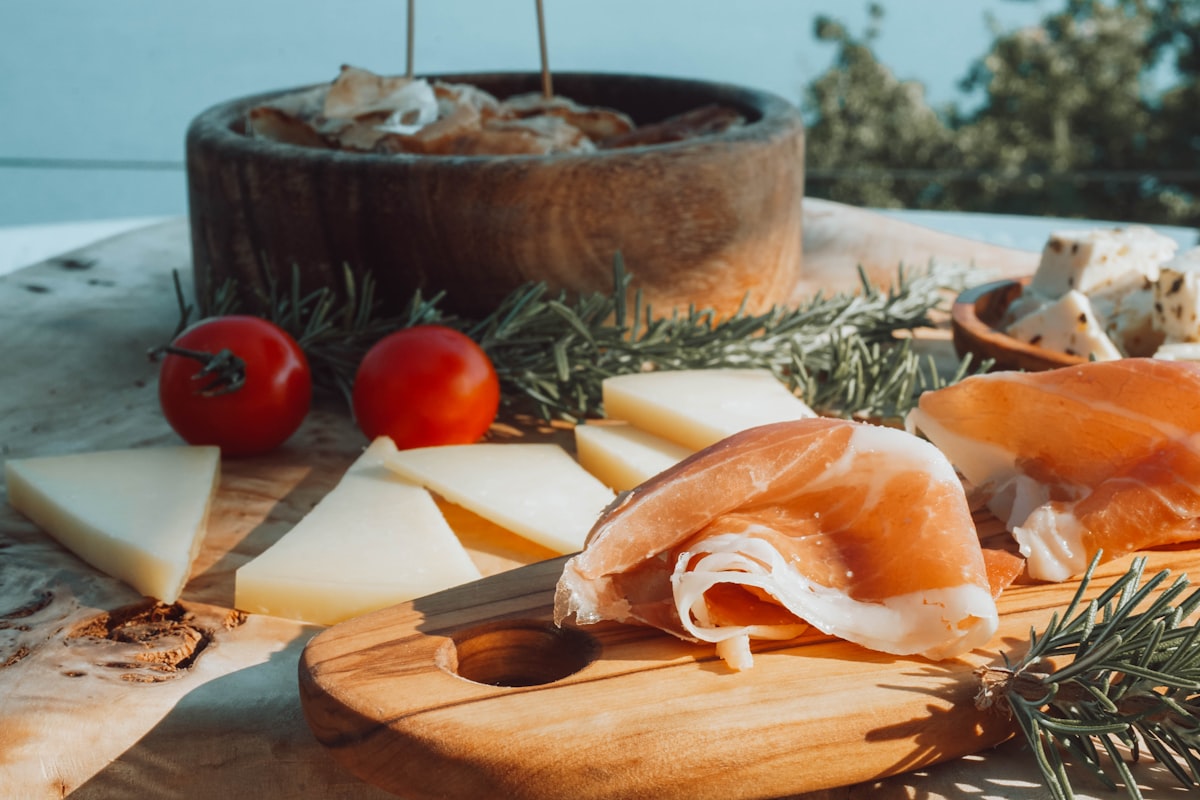
Montenegrin food sits at the intersection of Balkan, Venetian, and Ottoman culinary traditions. The coast leans heavily on seafood - grilled fish, black risotto, and shellfish pulled the same morning. The interior relies on slow-roasted meat, smoked prosciutto, and dairy products from highland pastures. The country is small but the difference between coastal and mountain cooking is significant.
All prices are in euros (€); Montenegro uses the euro.
Coastal and seafood dishes
Crni rižoto (black risotto)
Black risotto made with cuttlefish ink is one of the signature dishes of the Montenegrin and Dalmatian Adriatic. The ink gives it a dense, saline depth that plain seafood risotto does not have. Found at almost every good konoba along the bay and coast.
Grilled fish (riba na žaru)
Whole grilled fish - sea bass (brancin), sea bream (orada), or dentex (zubatac) - served with Swiss chard (blitva) and olive oil. Priced by weight; confirm before ordering.
- Typical price: €18–30 per kg (a whole sea bass for two is usually €20–35)
- Where: Any fish restaurant on the coast; the freshest in Perast and Tivat area
Školjke (shellfish - mussels and oysters)
The Bay of Kotor is known for farmed mussels and oysters. Mussels cooked in white wine and garlic (buzara) are served at most bay restaurants. Oysters from the Boka bay are increasingly promoted.
- Typical price: Mussels buzara €10–14; oysters €2–4 each
- Where: Konoba Catovića Mlini near Morinj, bay-side restaurants
Lignje (squid)
Grilled or fried squid is ubiquitous on the coast. Pržene lignje (fried rings) as a starter; grilled whole squid as a main.
- Typical price: €9–14
- Where: Everywhere on the coast
Mountain and inland dishes
Jagnjetina ispod sača (lamb under the sač)
Slow-roasted lamb under a metal bell covered with embers - the definitive mountain dish. Cooked for hours, the meat falls apart and is served with roasted potatoes and vegetables.
- Typical price: €14–22 per portion
- Where: Traditional konobas in Cetinje, Lovćen area, Durmitor region
Njeguški pršut (Njeguší prosciutto)
Air-dried smoked prosciutto from the Njeguši village, Montenegro’s most famous cured product. Drier and smokier than Italian prosciutto; served thin-sliced with Njeguški sir (cheese) as a starter or charcuterie board.
- Typical price: €8–14 as a starter; available at delis and markets
- Where: Produced in Njeguši village (between Kotor and Cetinje); served across the country
Njeguški sir (Njeguší cheese)
Hard, dry, smoked cheese from the same highland village as the prosciutto. Often served together.
- Typical price: €5–9 as part of a cheese board
- Where: Konobas throughout the country
Kajmak
Thick, clotted-cream-style dairy product made from slow-simmered milk. Served on bread, alongside grilled meat, or spread on burek. Saltier and richer than kajmak found in Serbia or Bosnia.
- Typical price: Included as a side at most traditional restaurants; standalone portion €3–5
Cicvara
Slow-cooked polenta-style dish made with corn flour and kajmak. Dense, warming, and characteristic of the northern highland cooking.
- Typical price: €6–9
- Where: Durmitor-area konobas and traditional restaurants in Cetinje
Pastries and street food
Priganice (fried dough)
Montenegrin fried dough balls, dusted with powdered sugar or served with honey and sour cream. The local equivalent of loukoumades or doughnuts - eaten as a breakfast or snack.
- Typical price: €3–5 for a portion
- Where: Breakfast spots and traditional cafés throughout the country
Burek
Present across all of Montenegro - flaky pastry filled with meat, cheese, or spinach. Cheaper and more filling at local pekare (bakeries) than at tourist restaurants.
- Typical price: €1.50–2.50 per slice at a pekara
- Where: Every pekara; most bus stations
Palačinke (crêpes)
Thin pancakes filled with jam, Nutella, honey, or cheese. Ubiquitous dessert or snack across the Balkans.
- Typical price: €2–4
Drinks
Vranac
Montenegro’s signature red wine grape. Full-bodied, dark, and tannic. The Plantaže winery near Podgorica is the largest producer; Vranac Pro Corde is a widely available premium label.
- Typical price: €4–8 per glass; €15–35 for a bottle
Loza / rakija
Grape brandy (loza) is the national spirit of Montenegro as it is across the Balkans. Homemade versions are strong (40–60% ABV). Also produced commercially by Plantaže.
- Typical price: €2–4 per glass at a bar or restaurant
Nikšićko pivo
Montenegro’s national beer, brewed in Nikšić. Available everywhere; the standard draught option.
- Typical price: €2–3 per 0.5L at a café or restaurant
Food prices by context
| Meal type | Typical price |
|---|---|
| Breakfast at a café (pastry + coffee) | €4–7 |
| Burek at a pekara | €1.50–2.50 |
| Lunch at a local konoba (2 courses) | €15–25 |
| Grilled fish dinner (mid-range) | €25–45 |
| Dinner at a good bay restaurant | €35–60 |
| Njeguški prosciutto starter | €8–14 |
A Kotor food walk (3 hours) is the most practical way to cover the key dishes and old town konobas in one session. Book accommodation in Kotor as your base — it’s the best starting point for both the coastal and mountain food scenes.
Plan your trip: Browse tours and activities in Montenegro - food tours are the fastest way into the local eating scene. Travel insurance and a Balkans eSIM are worth sorting before you fly.