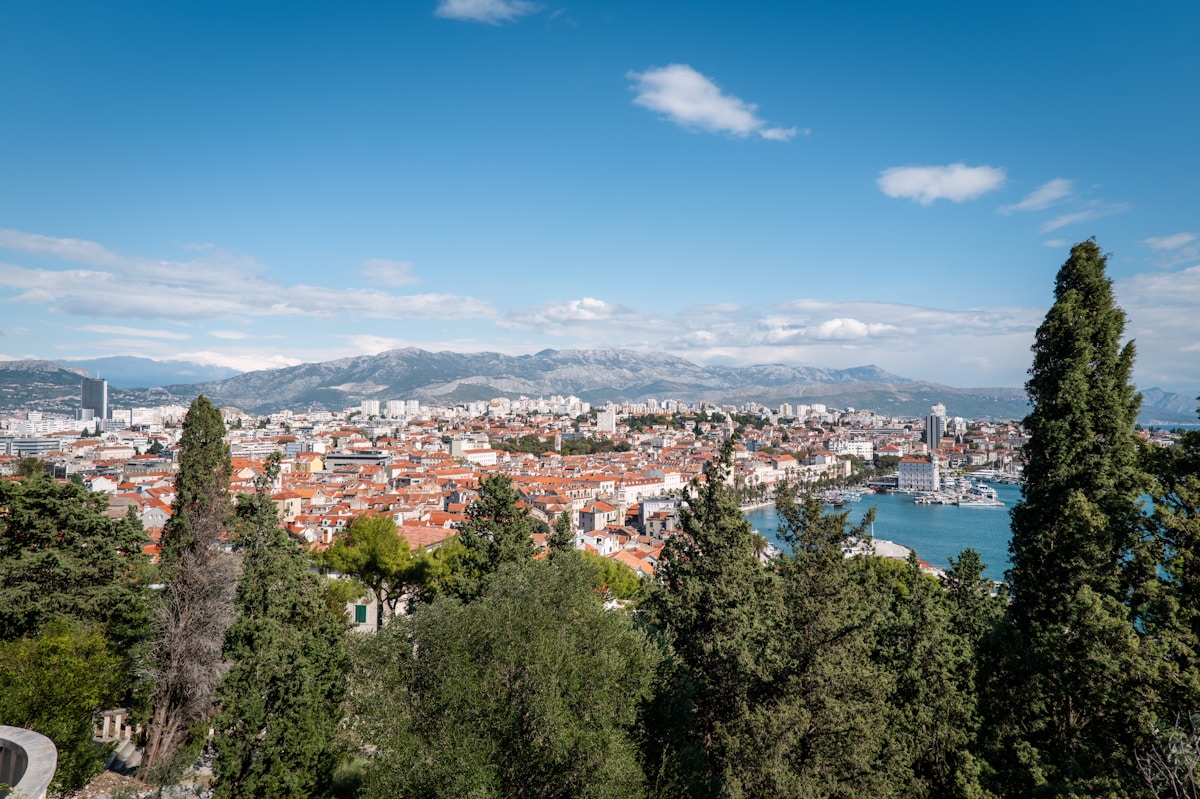
Split is Croatia’s second-largest city and the main ferry hub for the Dalmatian islands, which gives it a dual identity: a functioning urban centre with a year-round population, and one of the most visited coastal cities in the Adriatic. At its core is Diocletian’s Palace - a 4th-century Roman emperor’s retirement complex that was converted into a city as the empire collapsed. Roughly 3,000 people live inside the palace walls today.
Accommodation ranges from genuine budget hostels to international five-star properties, across neighbourhoods with meaningfully different characters.
The Main Areas
Old Town / Diocletian’s Palace
The palace complex covers roughly nine hectares and contains multiple residential layers - Roman, medieval, and modern - stacked within a roughly rectangular perimeter. Staying here means narrow stone passages, sudden piazzas, echoing cellars used as bars and restaurants, and the constant low-level noise of a lively city that does not entirely go quiet.
This is the most atmospheric option and the most convenient for waterfront dining, ferry access, and the main bus and tram stops. It is also the most expensive per square metre, and the pedestrian layout means no vehicle access for luggage - check-in logistics require wheeling bags over stone.
Varoš
Immediately west of the palace walls, Varoš is an older Croatian neighbourhood of steep streets, stone houses, and small konoba restaurants that cater more to residents than tourists. It connects the palace area with the Marjan Hill park above. Quieter than the palace district but walkable to everything. Several private room rentals here offer better value than equivalent Old Town apartments.
Meje
A residential area west of Varoš and below Marjan Hill, Meje is leafier and more spacious than the Old Town districts. The Bačvice beach - a famous shallow bay where Split locals play picigin (a traditional ball game unique to the city) - is a 15-minute walk east. Hotel Park, Split’s most prestigious address, sits in Meje.
Zenta
East of the Old Town, across the ferry terminal. Less pretty than the western neighbourhoods, but cheaper and practical for early morning ferry departures. Most accommodation here is apartment-style.
Budget Options (Under €80/night)
Split Backpackers Hostel (Old Town area, from approximately €20–35 per dorm bed): One of the longer-established hostels in Split, with a kitchen, social area, and central location. Private rooms from approximately €60–80. Reliable, if basic.
Hostel Emanuel (Varoš, from approximately €18–28 dorm): Smaller and quieter than the main backpacker hostels, in a stone building in Varoš. Fewer facilities but good value and character.
Private rooms in Varoš or Meje: Split has a long tradition of local families renting out rooms (the sobe signs in windows are a holdover from pre-internet tourism). Direct private room bookings - via Booking.com or arranged on arrival outside peak season - come in at approximately €50–80 for a double room with shared or en-suite bathroom.
Mid-Range Options (€80–200/night)
Hotel Peristil (Old Town, from approximately €140–200): A hotel inside the palace walls, directly adjacent to the Peristyle - the main courtyard of Diocletian’s complex. Eight rooms, each different, in a building that has occupied the palace since the 1980s. The location is genuinely exceptional; rooms are well-maintained but not lavish. Book well ahead for summer.
Hotel Art (Old Town, from approximately €120–180): A design hotel in a converted building near the Golden Gate, with more contemporary interiors than most palace-area options. Good breakfast and a small bar area. Prices are firm in peak season; shoulder-season rates can drop significantly.
Studio apartments in Varoš (from approximately €70–120): Several independent landlords rent apartments in Varoš with kitchenettes - useful for longer stays. Look for properties with reviews mentioning air conditioning, which is not always standard in older buildings.
Splurge Options (€200/night and above)
Cornaro Hotel (edge of Old Town, from approximately €200–350): A four-star property just outside the palace walls, with a rooftop terrace bar and well-equipped rooms that balance comfort with location. One of the better value options at the upper end of the market - not as famous as Hotel Park, but more convenient for most visitors.
Hotel Park Split (Meje, from approximately €200–400): The most iconic hotel in Split, a 1920s property facing the sea from Meje, renovated and relaunched in 2018. Large pool, spa, and sea-facing rooms with balconies. The distance from the palace (20-minute walk or short taxi) is the main trade-off, but for a beach-and-city combination it remains the city’s prestige address.
Radisson Blu Resort & Spa Split (Trstenik, approximately 3km east of Old Town, from approximately €180–320): A newer addition to Split’s upper-market options, with direct sea access and a pool. The location outside the city centre makes it better suited to those who want a resort rather than a city-base experience.
Practical Booking Advice
Split fills quickly in summer but not as rapidly as Dubrovnik - mid-season (late July) rooms are often still available in April, though prices rise. May and June are the safest times to find last-minute value.
The city’s tourist tax is added on top of accommodation costs: approximately 10–25 HRK (€1.30–3.30) per person per night. This is included in the quote on most booking platforms but worth confirming.
Note on ferry logistics: if you are catching an early morning ferry to Hvar or Brač (departures from 6:30am onwards), staying in Zenta or in Old Town apartments near the ferry terminal saves significant time versus commuting from Meje.
Split Airport (Kaštela) is approximately 24km from the Old Town. Kiwitaxi and Welcome Pickups offer pre-booked fixed-price transfers - a reliable option when arriving with luggage after a flight.
Best Area for First-Timers
The Old Town / Diocletian’s Palace area is the correct choice for a first visit, despite the premium. The logic of the city only becomes clear when you spend time inside the palace walls, and the convenience for restaurants, nightlife, and the ferry terminal is hard to replicate from further away. If the palace-area prices are not feasible, Varoš is the closest alternative - still walkable to everything, noticeably cheaper.
For day trips and local experiences, Split tours and activities cover Blue Cave excursions, Hvar island trips, and wine tours on the Dalmatian coast.
Compare prices and availability across all Split hotels - Search hotels in Split.
Plan Your Trip
Flights: Search flights to Split - Aviasales compares across airlines to find the best available price for your dates.
Airport transfer: Book a fixed-price transfer from Split Airport - Kiwitaxi confirms the full cost before you arrive.
Travel insurance: Get travel insurance for Croatia - covers medical, cancellation, and trip interruption.
eSIM: Buy an eSIM for the Balkans - Airalo data plans work across Croatia and the wider region, activated before you land.
See also: Split travel guide | Best hotels in Split | Best tours in Split | Where to stay in Dubrovnik