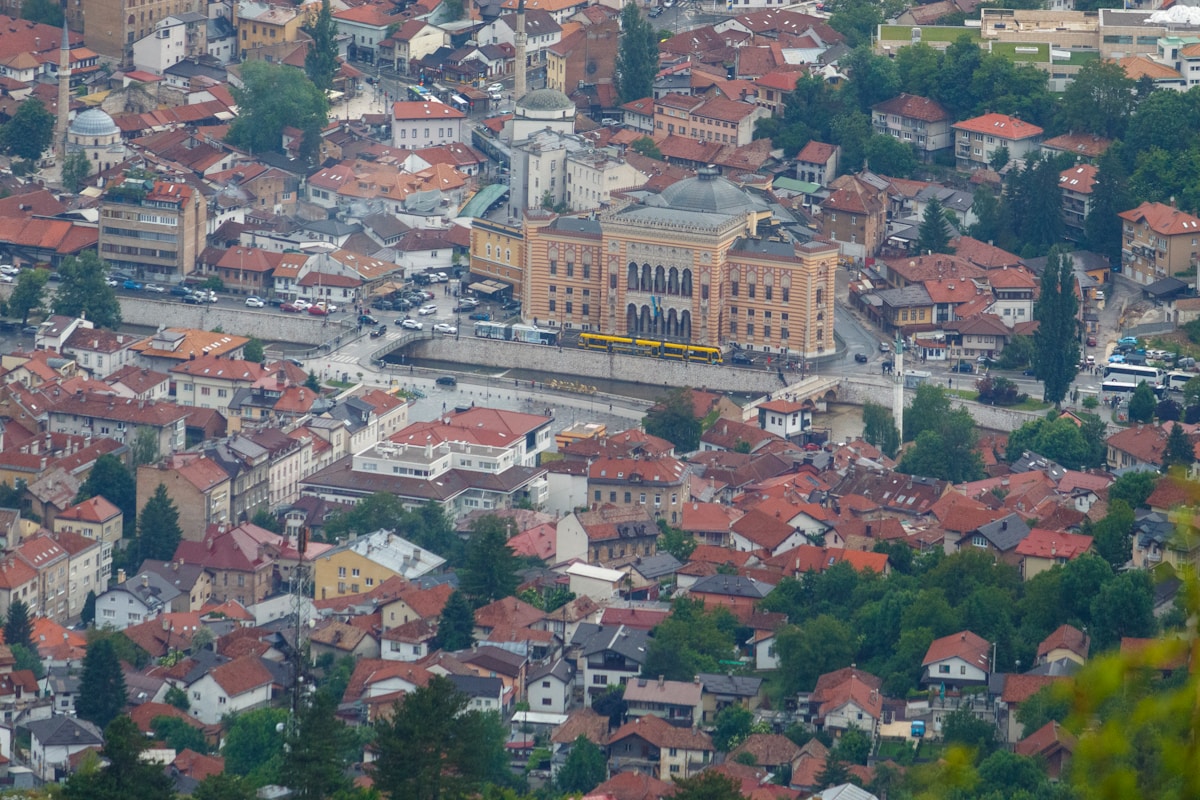
Sarajevo occupies a narrow valley carved by the Miljacka River, with the city stretching eastward from the airport through a sequence of historical layers: Yugoslav-era residential blocks give way to the Austro-Hungarian architecture of Ferhadija, then to the Ottoman bazaar of Baščaršija at the far end. The hills above hold Ottoman-era fortifications and, on the higher slopes, the cemeteries and ruins left by the 1992–1995 siege.
It is a city that requires time to understand. A two-night stay gives you the surface; three to four nights lets the layers become legible.
The Main Areas
Baščaršija (Old Bazaar Quarter)
The Ottoman core of Sarajevo, around the Gazi Husrev-beg Mosque and the Baščaršija square with its Sebilj fountain. The streets follow a medieval pattern - narrow, winding, lined with small workshops (coppersmithers, leather workers, jewellers) alongside the now-omnipresent tourist cafés and cevapi restaurants.
Staying in Baščaršija puts you inside Sarajevo’s most historically distinct neighbourhood, close to the National Museum, the Old Synagogue, the Orthodox cathedral, and the Latin Bridge where Archduke Franz Ferdinand was assassinated in 1914. It is also the densest area for the cafés and restaurants that define Sarajevo’s social culture.
Noise levels in summer are moderate - more neighbourhood than nightclub district.
Ferhadija / City Centre
Running west from Baščaršija, Ferhadija is the main pedestrian street and the spine of the Austro-Hungarian city built after 1878. The Sacred Heart Cathedral, the National Theatre, and the main commercial zone are here. A more urban and less atmospheric neighbourhood than Baščaršija, but hotel stock is higher and prices can be slightly lower for equivalent rooms.
The area around Markale market and Titova Street - the functional centre of modern Sarajevo - has several mid-range and business-oriented hotels that are well-positioned for both sightseeing and transport connections.
Grbavica
South of the Miljacka River, across from the city centre, Grbavica is a residential neighbourhood that saw some of the worst fighting during the siege. It is now largely rebuilt, with local cafés, apartment buildings, and a more everyday urban character than the tourist-facing neighbourhoods. Accommodation is cheaper here, and the tram connection into the centre runs frequently.
Grbavica suits travellers who prefer a local neighbourhood atmosphere over proximity to the main sights, and who are comfortable using public transport for a 10-minute commute to Baščaršija.
Ilidža
A spa suburb 12km west of the city centre, Ilidža is where the Bosna River emerges as a spring (the Vrelo Bosne park) and where the tram line terminates. Several larger hotel complexes with spas are located here, along with the suburb’s own market and a gentler pace than the city proper. Best suited to longer stays or those specifically seeking spa access.
Not recommended as a base for a first short visit - the tram journey into the centre takes around 30 minutes.
Budget Options (Under €60/night)
Franz Ferdinand Youth Hostel (Baščaršija, from approximately €15–25 per dorm bed): Named for the historical irony of its location near the Latin Bridge. Centrally placed in the old town area, with a social common room and helpful staff. Private rooms from approximately €40–55. Consistently well-reviewed.
Hostel Balkan Han (Baščaršija, from approximately €15–22 per dorm): A smaller hostel in a traditional building near the bazaar core. Limited facilities but strong location and a warm atmosphere. Good choice if you want to be in the heart of the old quarter.
Private rooms and pansioni: Sarajevo has a tradition of small family-run guesthouses (pansioni) in the Baščaršija area that offer private rooms with shared or en-suite bathrooms at approximately €35–60 per night. Booking.com lists many of these; look for properties with recent reviews and confirmed air conditioning, which is important in July–August when valley temperatures rise significantly.
Mid-Range Options (€60–150/night)
Hotel Latinski Most (Baščaršija, from approximately €60–100): Named for the Latin Bridge nearby, this hotel sits in the historical heart of the city. Clean, comfortable rooms with solid service; the location near the Assassination corner makes it a logical base for visitors interested in the city’s 20th-century history. Reliable breakfast included.
Hotel Michele (Baščaršija, from approximately €70–110): A family-run hotel in a converted building in the old quarter, with more individual character than the chain-adjacent options. Twelve rooms, private parking available on request, and a breakfast room that manages to feel genuinely welcoming rather than hotel-functional.
Hotel Astra (Ferhadija, from approximately €65–110): A three-star hotel on the main pedestrian street, well-positioned for the Austrian-era city and a 10-minute walk from Baščaršija. Standard business hotel features - reliable wifi, consistent service, air conditioning - at prices that remain competitive.
Splurge Options (€130/night and above)
Hotel Europe (Ferhadija, from approximately €140–250): Sarajevo’s most historic hotel, a 1882 establishment that hosted Austro-Hungarian nobility and continues as the city’s grandest address. The facade and public areas retain their original character; rooms have been modernised without losing period detail. The café is a Sarajevo institution. At the upper end of local pricing, but reasonable by any European five-star comparison.
Hotel Hills Sarajevo Resort & Casino (Ilidža, from approximately €130–220): A large resort property outside the city, with a casino, pool, spa, and conference facilities that make it more suited to business travel or longer stays than to the typical first-visit city trip. The Ilidža location is a genuine trade-off for centrally focused sightseeing.
Residence Iris Hotel & Resort (Ilidža, from approximately €120–180): Similar positioning to Hotel Hills - a spa and resort property in the suburbs, better value per room than the city-centre options at the same price tier but requiring the tram commute. Suits those who want a pool and quieter surroundings.
Practical Booking Advice
Sarajevo accommodation does not reach the same demand pressures as Dubrovnik or Split. Booking a month ahead is generally sufficient for most of the year; peak season (June–August) benefits from earlier booking for the better Baščaršija properties, which have limited room counts.
Currency: Bosnia uses BAM (konvertibilna marka), fixed at approximately 1 BAM = €0.51. Euros are accepted at many hotels but change is returned in BAM. ATMs are widely available; cards accepted at hotels and most restaurants.
Internet: Sarajevo’s infrastructure is better than many visitors expect. Hotels in all categories typically have reliable wifi; mobile data through a Bosnian SIM card or an eSIM is fast and inexpensive.
Best Area for First-Timers
Baščaršija is the right choice for a first visit without question. The atmosphere is unlike anywhere else in the Balkans - a functional Ottoman bazaar that has been commercial continuously for five centuries - and the concentration of restaurants, cafés, and historical sites within a ten-minute walk makes it the most time-efficient base. The price premium over Grbavica is modest and justified.
For deeper exploration of the city, Sarajevo tours and day trips include war history walks, Tunnel of Hope visits, and day excursions to Mostar.
Compare prices and availability across all Sarajevo hotels - Search hotels in Sarajevo.
Plan Your Trip
Flights: Search flights to Sarajevo - Aviasales compares across airlines and OTAs to find the best available price for your dates.
Airport transfer: Book a fixed-price transfer from Sarajevo Airport - Kiwitaxi shows the full cost upfront before you confirm.
Travel insurance: Get travel insurance for Bosnia - covers medical, cancellation, and trip interruption.
eSIM: Buy an eSIM for the Balkans - Airalo data plans work in Bosnia and across the region, activated before you land.
See also: Sarajevo city guide | Best hotels in Sarajevo | Best tours in Sarajevo | Bosnia & Herzegovina travel guide